
TDSLab Series Thermal Desorption Spectrometers
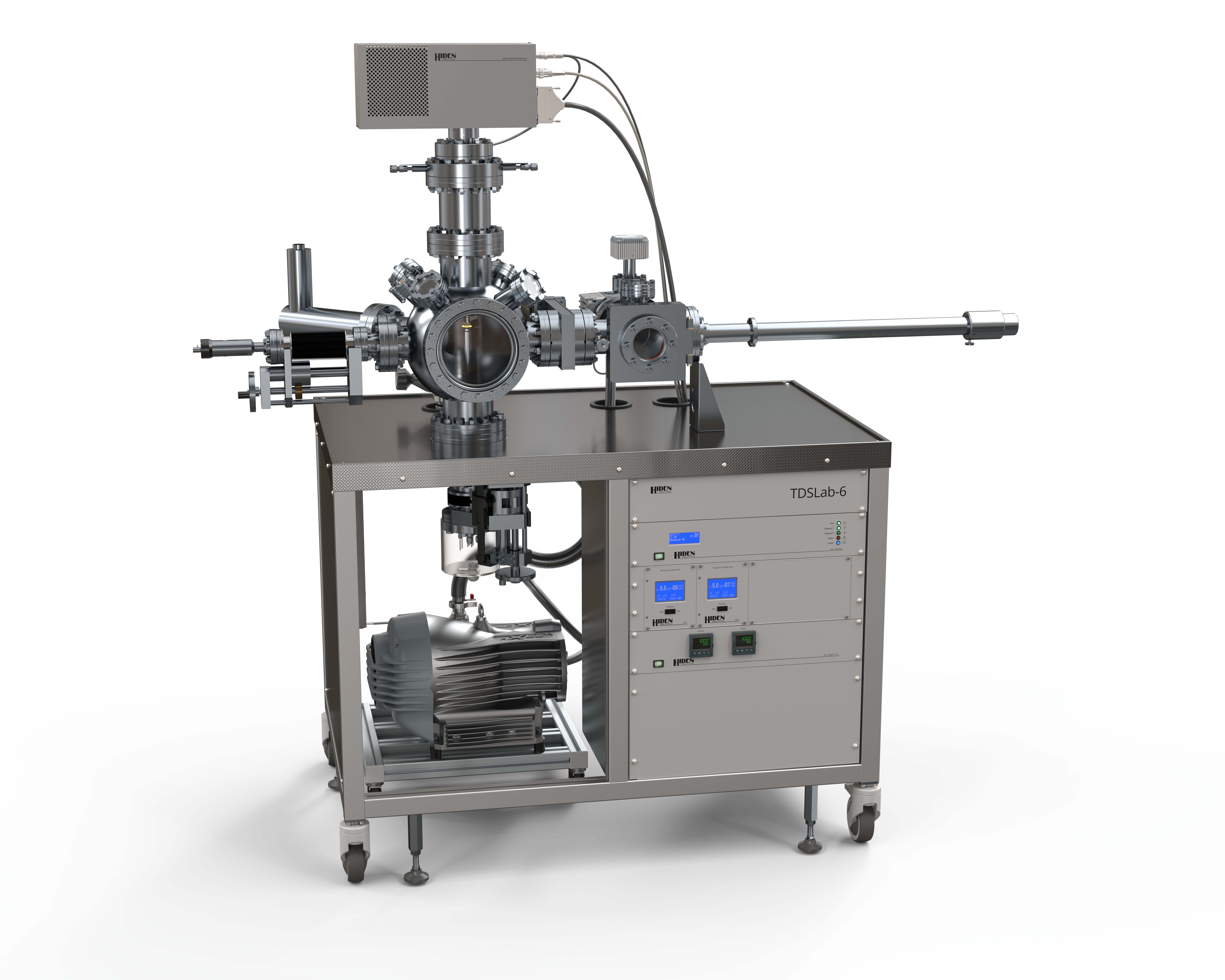
The TDSLab Series combines ultra-high-vacuum thermal desorption spectroscopy with quadrupole mass spectrometry for controlled studies of gases released from metals and advanced materials. Three configurations address sensitive hydrogen measurements in steel, high-mass species from semiconductor and photovoltaic materials, and hydrogen-isotope research.
Applications
TDSLab provides an integrated UHV workstation for temperature-programmed desorption and thermal desorption spectroscopy. Samples can be heated to 1,000 °C under PID control while the mass spectrometer records evolved species against temperature. A water-cooled shroud and mass-filter shroud help reduce background signals, and TPDsoft supports temperature-ramp control and synchronised data acquisition.
Choose TDSLab-6 for quantitative hydrogen desorption analysis in steel and other metals, with a detection capability of 0.01 ppm hydrogen in steel. The resulting hydrogen-desorption data support hydrogen embrittlement research by characterising hydrogen behaviour in steels and other advanced materials.
TDSLab-9 extends the mass range for photovoltaic and semiconductor research, while TDSLab-20 is configured for demanding fusion and isotope applications. These options allow laboratories to match sensitivity, mass range and sample configuration to the material under investigation.
• 1,000 °C sample stage with PID control module for precise temperature management
• High-precision triple-filter quadrupole mass spectrometer with a digital pulse-ion-counting detector for detailed gas analysis
• Multiport UHV chamber for complex experimental setups
• Water-cooled heater shroud to minimise outgassing and speed up cooling
• Linear sample-transfer mechanism and loadlock with a gate valve and viewports for operational flexibility
• Z-drive for optimal sample and detector positioning
• Mass-filter shroud to increase sensitivity and reduce background interference
• TPDsoft control and analysis software for experiment management and data analysis
• Bakeout jacket rated to 150 °C to reduce downtime between experiments
Application note AN-10035.1: Analysis of Coated Silicon Surfaces by TPD/TDS
Isothermal Desorption Spectroscopy (ITDS) | Imperial College London
Research using the Hiden TPD Workstation for Isothermal Desorption Spectroscopy (ITDS).
MRF Tritium Capability | NNUF
Research using the Hiden TPD Workstation for Thermal Desorption Spectroscopy (TDS).
Keszler Research Group | Oregon State University
Research is directed to the synthesis and study of inorganic molecules and materials that will enable next-generation electronic and energy devices
National Science Foundation
Sustainable chemistry center works to transform electronics manufacturing — Science Nation
