
Hydrogen embrittlement is a major obstacle to the safe and reliable deployment of metallic materials in hydrogen energy and infrastructure. Since hydrogen interacts strongly with grain boundaries, clarifying how grain boundaries respond to hydrogen is essential for understanding and mitigating hydrogen-induced degradation.
In the paper “New insights into hydrogen-assisted intergranular cracking in nickel”, we presented a comprehensive study to examine the resistance of different grain boundary types to hydrogen-assisted intergranular cracking in pure nickel based on the coincident site lattice (Σ) values.
Accurate quantification of hydrogen content was achieved using thermal desorption analysis employing instrumentation from Hiden Analytical, enabling a reliable correlation between hydrogen concentration and hydrogen-assisted intergranular cracking.
The results indicate that Σ3 grain boundaries in pure nickel exhibit the highest resistance to hydrogen-assisted intergranular cracking across a wide range of hydrogen concentrations. Under all conditions examined, Σ3 boundaries show fewer instances of crack initiation and propagation compared with other grain boundary types. Importantly, this trend is observed for both surface and bulk cracking, inferring that the resistance of Σ3 boundaries is independent of the crack location.
These findings provide direct experimental evidence that the degree of lattice coincidence at grain boundaries, as described by their CSL value, plays a role in hydrogen-assisted intergranular cracking in pure nickel. The resistance of Σ3 boundaries identified in this study have been established by rigorous experimental results that contrast with previous observations in nickel-based alloys, where Σ3 boundaries have been reported to be susceptible to hydrogen-assisted intergranular cracking. These results support future studies of grain boundary susceptibility in various metallic materials, contributing to a deeper understanding of hydrogen embrittlement mechanisms.
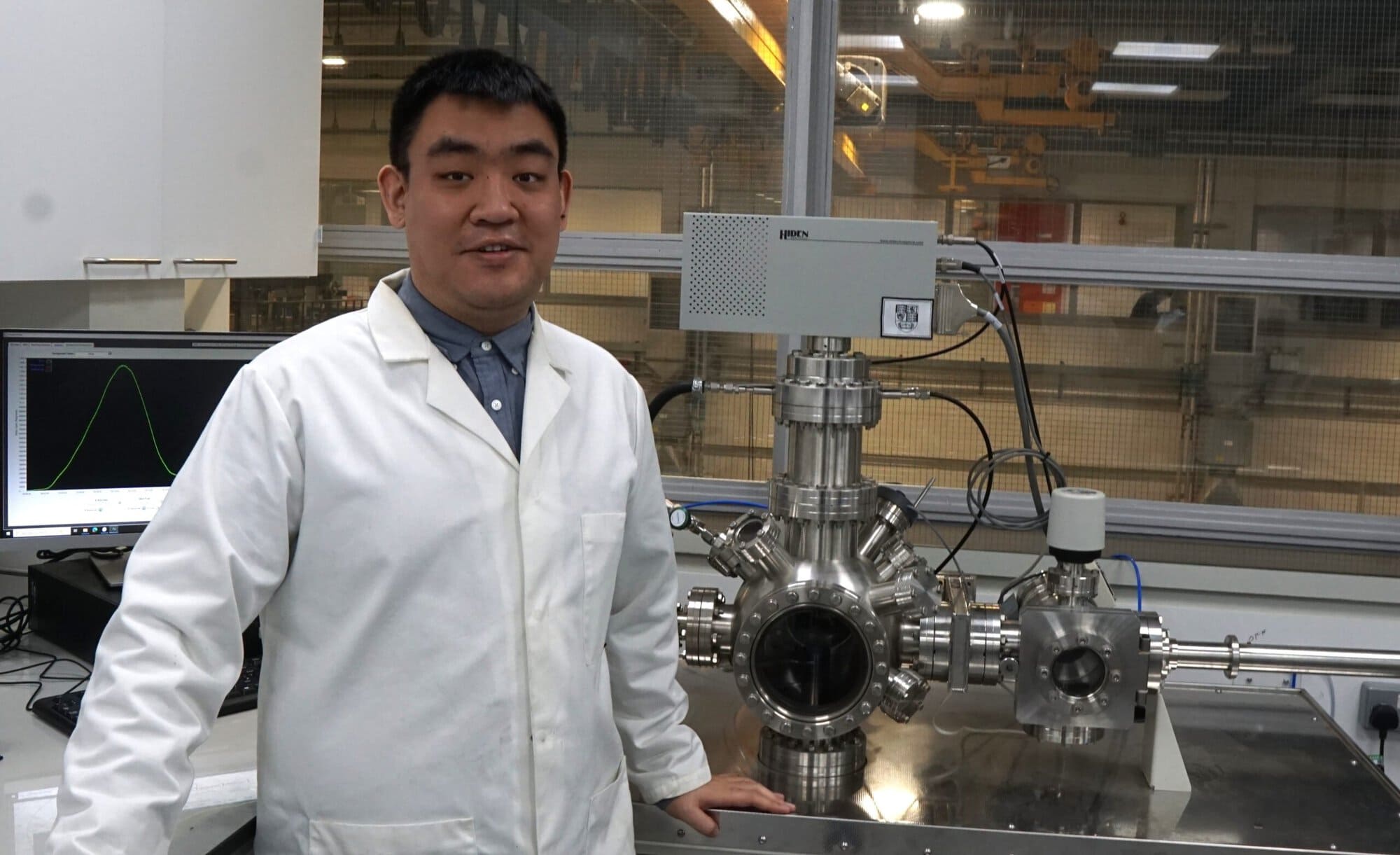
Figure 1. Sangchu Quan with the Hiden TPD Workstation (now known as TDSLab Series).
Overall, this study shows that Σ3 grain boundaries in pure nickel are much more resistant to hydrogen-assisted intergranular cracking than other boundary types. By clearly linking grain boundary crystallography with hydrogen-induced cracking behaviour, the work provides practical insight into how hydrogen embrittlement can be reduced. This understanding promotes the design of more reliable metallic materials for hydrogen-related applications and supports the long-term development of a safe and sustainable hydrogen economy.
Project Summary by: Sangchu Quan and Dr Livia Cupertino-Malheiros, Imperial College London, London, England.

Paper Reference: Quan, S., Zafra, A., Martínez-Pañeda, E., Wu, C., Harris, Z.D. and Cupertino-Malheiros, L., 2025. New insights into hydrogen-assisted intergranular cracking in nickel. Materials Science and Engineering: A, p.149545. DOI: 10.1016/j.msea.2025.149545.
Hiden Product: TPD Workstation (now known as TDSLab Series).
