
Secondary Ion Mass Spectrometry (SIMS) for Surface Analysis: A Technique Overview
What is Secondary Ion Mass Spectrometry?
Secondary Ion Mass Spectrometry (SIMS) is the most sensitive surface analysis technique, providing quantifiable data to the ppb level and surface specificity to the uppermost monolayer. It can be used to analyse most solid vacuum compatible materials including:
- Metals
- Semiconductors
- Ceramics
- Polymers
- Biological material.
The sample is bombarded by a beam of ions, the primary ions, which sputter erode the surface. As a result of the energetic sputtering process, some of the ejected material (either atoms or molecules) is ionised, the secondary ions, and can thus be directed towards the mass spectrometer where detection is made.
How does Secondary Ion Mass Spectrometry?
The sample is bombarded by a beam of ions, the primary ions, which sputter erode the surface. As a result of the energetic sputtering process, some of the ejected material (either atoms or molecules) is ionised. These become, the secondary ions, and can be directed towards the mass spectrometer where detection is made.
Interaction of the primary beam with the target
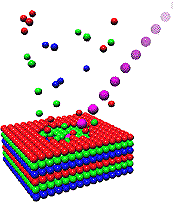 When a primary ion impacts the specimen it gives up its energy through a series of collisions with target atoms which recoil and, in turn, collide with their neighbours. If they have sufficient energy, these will also go on to collide with other atoms, resulting in a collision cascade. At some point, the cascade may intersect the surface. The energetic particle, instead of colliding with a nearby atom, may escape from the material. If conditions are favourable, the emitted particle may be in an ionised state. Generally, although the primary ion may penetrate many nanometres into the target, the ejected ions come from only the uppermost few atomic layers.
Although the volume of each cascade is small (5-10nm in diameter), the effect of successive cascades over time is the formation of a mixed or altered layer at the exposed surface of the specimen. This layer comprises a mixture of sample and primary beam species. The thickness of the altered layer varies considerably with species and energy, and can range from around one nanometre at low energy, to 10nm or more at higher energies. The chemistry of the beam and target is also important, as the ion yield (the fraction of the material that is ejected in an ionised state) varies significantly and non-linearly, with the local surface chemistry. Therefore if a suitable altered layer is created, the ion yield will be enhanced with consequent improvement in sensitivity.
Static SIMS
Static SIMS is a highly surface sensitive technique, ideally sampling the uppermost monolayer of the material. To achieve this, a very low ion dose is required, so that collision cascades do not overlap and emitted ions arise only from the virgin surface. Statistically, a dose of less than 1,012 atoms cm-2 will ensure that the cascades do not overlap – this is generally regarded as the static SIMS limit. The primary ion beam may either be defocused or raster scanned across the sample to access a greater area for analysis.
The energy or chemistry of the primary beam is of less importance, as most of the primary ions become implanted in the target and there deliberately insufficient to cause mixing. It is desirable, however, not to use the same beam species as one that may be of importance in the sample; thus if oxygen is of interest, an argon or xenon beam should be used in a gas source gun.
The output data of a static SIMS experiment is a mass spectrum. On the basic level, this will show the elements present. If the molecular signals are investigated, then specific functional groups may be observed, such as PO2- or SO2- at mass 63 and 64 respectively, indicative of phosphate or sulphate on the surface, possibly from a cleaning agent.
Further inspection of the spectrum may reveal significant groups at higher masses. This is especially true for polymers where the polymeric backbone may fracture at specific places, giving rise to characteristic or fingerprint spectra, which may be used to identify the material.
Dynamic SIMS
As the ion dose is increased, and more material is ejected, the surface begins to recede. If specific masses are chosen and their signals followed as a function of sputter time, a depth profile of their concentration will be produced. Dynamic SIMS is unsurpassed by other surface analytical techniques, both in terms of the sensitivity it can achieve and the fact that it can analyse the entire periodic table.
The primary ion beam is raster scanned, usually in a square, across the sample surface, so that a well defined, flat bottomed, crater is produced. As the ion beam has a generally Gaussian distribution, the crater edges are somewhat curved, and when the beam is in their vicinity, ions characteristic of a crater wall will be emitted. To overcome this, ions are recorded only when the beam is within a central area on the crater floor, a region termed the gate.
Dynamic SIMS is an extremely sensitive analytical tool and is often the only technique that can detect interface contamination in layered structures, or doping in semiconductors. The highest sensitivity requires the largest possible fraction of the emitted material to be ionised. The possibility of an ejected atom or molecule being emitted in the ionised state depends strongly on the chemical environment from which it arose, and can vary by orders of magnitude. The reactive ion beams oxygen and caesium maximise the yield of electropositive and electronegative species respectively by modifying the chemistry of the altered layer. In the case of oxygen bombardment, a thin (1-20nm) stoichiometric oxide may be formed.
When bombardment first begins, primary ions are implanted into the target and only target material is sputtered (Static SIMS). As more primary ions are implanted, and the altered layer begins to form, the surface chemistry is modified, becoming a mixture of both target and primary. Eventually, the number of previously implanted primary ions being ejected, and the number of new ones arriving becomes equal and a steady state condition arises. A SIMS depth profile can subsequently be divided into two parts, the near surface (typically 2 – 20nm) pre-equilibrium and the deeper equilibrium regions.
In the pre-equilibrium region, the surface chemistry is rapidly changing and thus the ion yield is unstable. Similarly, because initially only target material is ejected, the erosion rate of the surface is higher than at equilibrium, when both target and primary beam material are sputtered.
Quantification
Once equilibrium is reached, the ion and sputter yields stabilise and accurate quantification can be made.
The depth scale is generally applied by measuring the depth of the crater using either a surface profilometer or interference microscope, and assuming a constant erosion rate. Alternatively, if the erosion rate is known from a previous calibration or analysis of a layer of known thickness, then this can be used, assuming similar bombardment conditions. It must be remembered that different materials sputter at different rates; hence, in a multilayer system, an erosion rate should be determined for each layer. Once this is done, the relative erosion rate between layers can be applied in future similar analyses.
To calibrate the concentration requires a material of similar, and known, composition. For example, if one is required to calibrate for boron in silicon, then a reference material is required having a known amount of boron in silicon. This calibration will only apply to the B in Si system and could not, for example, be used to determine the amount of boron in stainless steel, or even another semiconductor.
The most widely applied quantification scheme is the relative sensitivity factor, RSF, where the signal arising from an impurity in a matrix is related directly to a signal of the matrix. The use of the RSF is defined by –
Impurity concentration (atoms cm-3) = RSF (Impurity signal / Matrix signal)
Note that the RSF is highly dependent on the instrument conditions, and for accuracy should be determined at the same time as the unknown sample is run. The fact that the ion yield varies for each matrix – impurity combination brings with it the implicit requirement for known reference materials. Where bulk references are not readily available, ion implantation is generally the preferred route to making reference samples. It should be noted that the RSF method implies a dilute impurity in a homogeneous matrix. When the impurity levels rise above a few percent, the ion yield may begin to vary, and the accuracy of the quantification will fall.
Depth resolution
The depth resolution of a SIMS depth profile depends upon a number of factors, not least the original surface roughness. Except in special circumstances, the depth resolution cannot be expected to be better than the microscopic surface roughness. Assuming a very flat surface, like a semiconductor wafer or glass plate, it is the thickness of the altered layer that has the most direct impact on depth resolution. The continual mixing and remixing in the layer results in a reservoir of species which are released at a fixed rate. This leads to the characteristic exponential tail (linear on a log plot) seen in SIMS depth profiles of sharp layers.
If the altered layer thickness is reduced, by changing the bombardment conditions such as impact energy, then the decay will become steeper. Depth resolution is measured in terms of:
- The decay length
- Id
- The distance over which the signal falls by a factor e
- The natural log base
It is also sometimes described in nm/decade, as this is easy to estimate from a graph. SIMS depth profiles are presented, almost universally, with logarithmic concentration axis due to their high dynamic range.
Artefacts
In common with all analytical techniques, SIMS analyses may contain deleterious artefacts that can mislead the user. Below are the most common and important techniques:
1. Charging
The surface of insulators, some semiconductors and some interfaces may charge during analysis. This is generally seen as a fall in all signals as the ion energy becomes shifted out of that to which the spectrometer is tuned. The solution is to use an electron gun to equalise the charge or to introduce photons of sufficient energy to promote carrier creation.
2. Mass interference
Some molecular signals may have a similar mass to that of an ion which is being sought and cause interference. An example would be Si2O at mass 75. If arsenic were being sought in silicon dioxide, then this would give rise to a background signal at mass 75. Arsenic is monoisotopic, hence there is no possibility of choosing a different isotope free from the interference.
One solution is to recognise that molecular SIMS signals have much narrower energy distributions than atomic signals, hence by tuning the spectrometer (or shifting the sample potential) so that higher energy ions are collected, and the dynamic range will be improved (at the expense of lower signal levels). It is important to choose species carefully.
3. Chemical segregation
Sometimes, long tails will be observed on depth profiles. These can arise especially when oxygen is being used as the bombarding species and an oxide is being produced in the altered layer. Some species are less soluble in the oxide and will segregate to the back being released very slowly and producing a long decay. If the bombardment angle is changed to give more grazing incidence (typically 60° to the surface normal), then the oxide may not be produced, and chemical segregation will not occur.
4. Roughness
There is little that can be done to reduce the effect of initial surface roughness. A rough surface will generally degrade the depth resolution, even if a layer is conformal to the roughness as the erosion rate depends on angle. This is especially true if the topography is angular. However, many materials can develop a rough surface during analysis, and this can be observed as a degradation of depth resolution with depth and / or a change in sputter rate. Roughness development may be reduced by using near normal incidence or grazing incidence bombardment. Protection against roughness development, very useful on metals, can be achieved by bombarding obliquely and continually rotating the sample during analysis.
Please contact us if you require any futher information.
