
Decentralised electrochemical technologies based on hybrid electrochemical advanced oxidation processes (EAOPs), which integrate contaminated water treatment with the simultaneous green chemical feedstocks and hydrogen (H2) production, are a promising strategy within the framework of the current energy transition. In this context, an innovative hybrid electrochemical advanced oxidation process reactor is presented that simultaneously treats contaminated water while producing high-purity green hydrogen (H₂). The central novelty lies in coupling the reactor with Differential Electrochemical Mass Spectrometry (DEMS), enabling, for the first time, real-time monitoring of gaseous products generated during electrochemical wastewater valorisation.
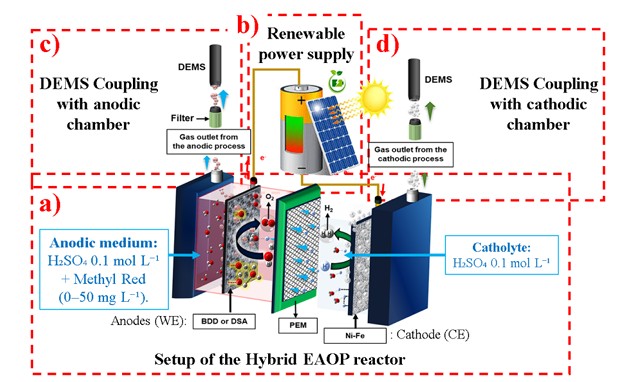
Figure 1. Schematic representation of the experimental setup used for electrochemical valorisation coupled with DEMS gas detection (a) hybrid EAOP reactor, (b) renewable power supply, and (c-d) DEMS coupling with anodic and cathodic chambers.
The study compares the performance of two anodic materials with fundamentally different electrochemical behaviours: boron-doped diamond (BDD), a non-active anode, and a dimensionally stable anode (DSA, Ti/SnO₂–IrO₂–Sb₂O₃), an active anode. The results demonstrate that the anode material dictates the oxidation pathway. BDD promotes highly non-selective oxidation through hydroxyl radicals and sulphate-derived oxidants, resulting in rapid mineralisation of the organic pollutant. Consequently, chemical oxygen demand (COD) removal exceeded 95%, and significant CO₂ evolution was detected, indicating extensive mineralization of methyl red. In contrast, DSA favours partial oxidation, leading to the accumulation of valuable short-chain carboxylic acids (SCCAs), such as oxalic, maleic, malonic, and formic acids, while producing negligible gaseous CO₂. These findings illustrate the possibility of tailoring electrochemical reactors either for pollutant destruction (BDD) or for selective electroconversion into value-added chemicals (DSA). Electrochemical characterisation (polarisation curves, Tafel analysis, and electrochemical impedance spectroscopy) explains these contrasting behaviours. BDD exhibits a higher oxygen evolution overpotential, allowing more charge to be directed toward the generation of reactive oxidising species rather than oxygen evolution. Conversely, DSA displays faster oxygen evolution kinetics and pseudocapacitive behaviour, promoting surface-mediated selective oxidation instead of complete mineralisation. These intrinsic electrode properties directly determine oxidant generation, reaction selectivity, and overall process efficiency.
A major contribution of the work is the comprehensive analysis of hydrogen production during simultaneous wastewater treatment. DEMS confirmed that the cathodically generated gas consisted of more than 99% pure hydrogen, with Faradaic efficiencies close to 100%. Interestingly, although the hydrogen evolution reaction remained kinetically independent of the anodic oxidation mechanism, the hydrogen production rate was influenced by the organic load and by the choice of anode because these factors altered charge distribution, proton transport through the PEM, and the electronic balance of the system. BDD generally produced slightly higher hydrogen yields than DSA. The authors conclude that integrating DEMS with hybrid EAOP reactors provides unprecedented mechanistic insight into gas evolution while offering a promising platform for decentralised wastewater treatment, renewable hydrogen production, and the generation of value-added chemical feedstocks, thereby advancing the concepts of circular economy and sustainable electrochemical technologies.
Project Summary by: Dr. Elisama Vieira dos Santos, Associate Professor, Affiliate member of the Brazilian Academy of Sciences, Federal University of Rio Grande do Norte, Campus Universitário, Lagoa Nova – CEP: 59.072 970, Natal, Brazil.

Paper Reference: Loor-Urgilés, L.D., Feijoó, T.N., Santos, D.R.F., Quiroz, M.A., Mendez, E., dos Santos, E.V. and Martínez-Huitle, C.A. (2026). Real-time DEMS monitoring of gas evolution in a hybrid integrated EAOP reactor for electrochemical valorisation of polluted water toward green chemical feedstocks. Electrochimica Acta, 566, p.148755. DOI: 10.1016/j.electacta.2026.148755.
Hiden Product: HPR-40 DEMS.
Reference Number: AP-HPR-40-202326.
HPR-20 OEMS now equivalent Hiden product to HPR-40 DEMS with QIC heated flexible capillary inlet with ultra-low flow sample flow rate – 250 µLmin-1 as used in this research.
