
The Hiden Analytical mass spectrometer (HPR-20 EGA) has been employed in laboratory of heterogeneous catalysis research group at the Institute of Environmental Technology – CEET VSB-TUO, Czech Republic, for several years as a complementary analytical tool, installed in series downstream of a chemisorption analyser. In this configuration, it serves as a highly sensitive detector that significantly extends the analytical capabilities of setups, particularly those relying solely on thermal conductivity detection (TCD).
Figure 1 (right). HPR-20 EGA, Hiden Analytical.
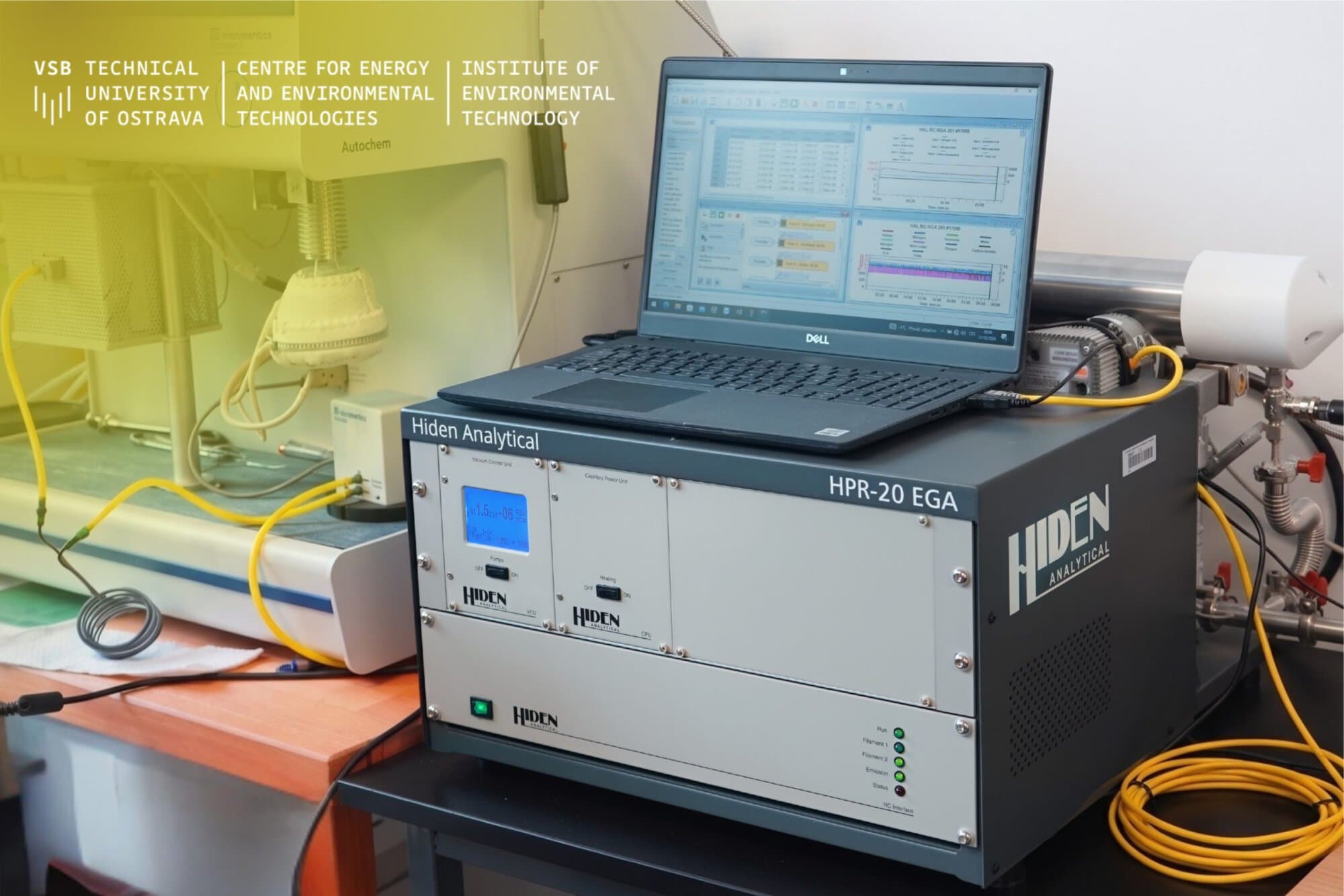
Our research activities encompass not only the investigation of catalytic reactions themselves, but also an in-depth physicochemical characterisation of catalysts. A substantial part of this effort is devoted to temperature-programmed techniques, which provide valuable insight into surface properties, active sites, and reaction intermediates. The data obtained from the mass spectrometer are systematically correlated with catalytic performance data, enabling a more comprehensive interpretation of reaction mechanisms and catalyst activity-structure relationship. These combined results form the basis of our scientific publications in peer-reviewed journals.
In recent studies, particular attention has been paid to hydrogen temperature-programmed reduction (H₂-TPR)1, 2. In these experiments, the mass spectrometer plays a crucial—rather than merely supportive—role, as it allows for the detection and identification of gaseous species that are not observable using a TCD detector. This is especially important for complex systems where multiple overlapping processes occur. For example, the use of the mass spectrometer enabled us to assign specific peaks in TPR profiles to the presence of nitrate species1, which would otherwise remain unresolved.
Beyond TPR, the Hiden Analytical mass spectrometer is routinely applied in a wide range of temperature-programmed desorption (TPD) experiments. These include NH₃-TPD¹, 3 for assessing catalyst acidity, H₂O-TPD4 for evaluating the interaction of materials with water vapour — an aspect critical for understanding catalyst performance under realistic, moisture-containing conditions—and CO₂-TPD5 for determining basicity. Additionally, H₂-TPD measurements1 are used to quantify hydrogen adsorption capacity, which is directly related to the availability of active metal sites.
Our work also extends to advanced characterisation techniques such as N₂O reactive frontal chromatography (RFC)1, 6, which is employed to determine Cu dispersion and surface structure. This method, in combination with mass spectrometric detection, offer a robust and detailed picture of catalyst properties.
Altogether, the integration of these experimental approaches is essential for the thorough understanding and elucidation of catalytic processes and their underlying mechanisms. The use of modern analytical instrumentation, particularly the Hiden Analytical mass spectrometer, enables precise monitoring of gas-phase species and significantly enhances the reliability and depth of our analyses.
Project Summary by: Ing. Kateřina Karásková, PhD, VSB – Technical University of Ostrava 17. listopadu 2172/15, 708 00 Ostrava-Poruba, Czech Republic.
Paper References: 1. Pacultová, K.; Karásková, K.; Fridrichová, D.; Bílková, T.; Dutta, S.; Aubrecht, J.; Kubička, D., Study of the adsorption of phenolics and furanics on the surface of Ni-Cu catalysts. Molecular Catalysis 2025, 586, Art. No. 115434. DOI: 10.1016/j.mcat.2025.115431.
- Pokorny, T.; Machac, P.; Moravec, Z.; Simonikova, L.; Leonova, L.; Hlavenkova, Z.; Skoda, D.; Pacultova, K.; Karaskova, K.; Styskalik, A., Ni- and Zn-Doping Effects on Cu/SiO2 Catalysts in Nonoxidative Ethanol Dehydrogenation. Ind. Eng. Chem. Res. 2026, 65, pp. 4716-4730. DOI: 10.1021/acs.iecr.5c04241.
- Górecka, S.; Pacultová, K.; Karasková, K.; Górecki, K.; Kupková, K.; Kinnertová, E.; Gimeno, A. E. P.; Obalová, L., Hydrotalcite-zeolite composites as precursors for catalysis: Synthesis, transformation and structural stability. Microporous Mesoporous Mat. 2026, 403, Art. No. 114031. DOI 10.1016/j.micromeso.2026.114031.
- Klegová, A.; Pacultová, K.; Kiška, T.; Karásková, K.; Bílková, T.; Obalová, L., Depositing Cs-Co3O4 on Ceramic Foam Fosters Industrial N2O Decomposition Catalysis. Eng 2026, 7, Art. No. 86. DOI: 10.3390/eng7020086.
- Imrichová, A.; Sokola, P.; Másilko, J.; Baláš, M.; Cába, V.; Karásková, K.; Švec, J.; Ptáček, P., The study of natural dolomite as a prospective material for CO2 capture employing a novel approach to the evaluation of breakthrough curves. Open Ceram. 2025, 24, Art. No. 100844. DOI: 10.1016/j.oceram.2025.100844.
- Górecka, S.; Kupková, K.; Pacultová, K.; Bílková, T.; Górecki, K.; Rokicinska, A.; Kustrowski, P.; Slowik, G.; Obalová, L., Effect of copper introduction via wet-impregnation on the performance of Mg-Al mixed metal oxides in selective ammonia oxidation. Applied Surface Science 2026, 727, Art. No. 165973. DOI: 10.1016/j.apsusc.2026.165973.
Hiden Product: HPR-20 EGA.
