
Lithium-ion cell failure can generate complex mixtures of flammable and toxic gases, with the final gas volume and composition influenced by cell chemistry, format, state of charge, abuse mechanism and test atmosphere. A recent Health and Safety Executive research programme brings these variables together in a comprehensive poster covering external heating, overcharge and nail penetration tests across multiple Li-ion cell formats and chemistries. Across the four papers summarised in the poster, gas samples generated during controlled failure testing were analysed using a Hiden Analytical HPR-20 TMS quadrupole mass spectrometer system, enabling quantitative comparison of key gaseous species including H₂, CO₂, CO, CH₄, C₂H₄, C₂H₆, C₃H₆ and C₃H₈.
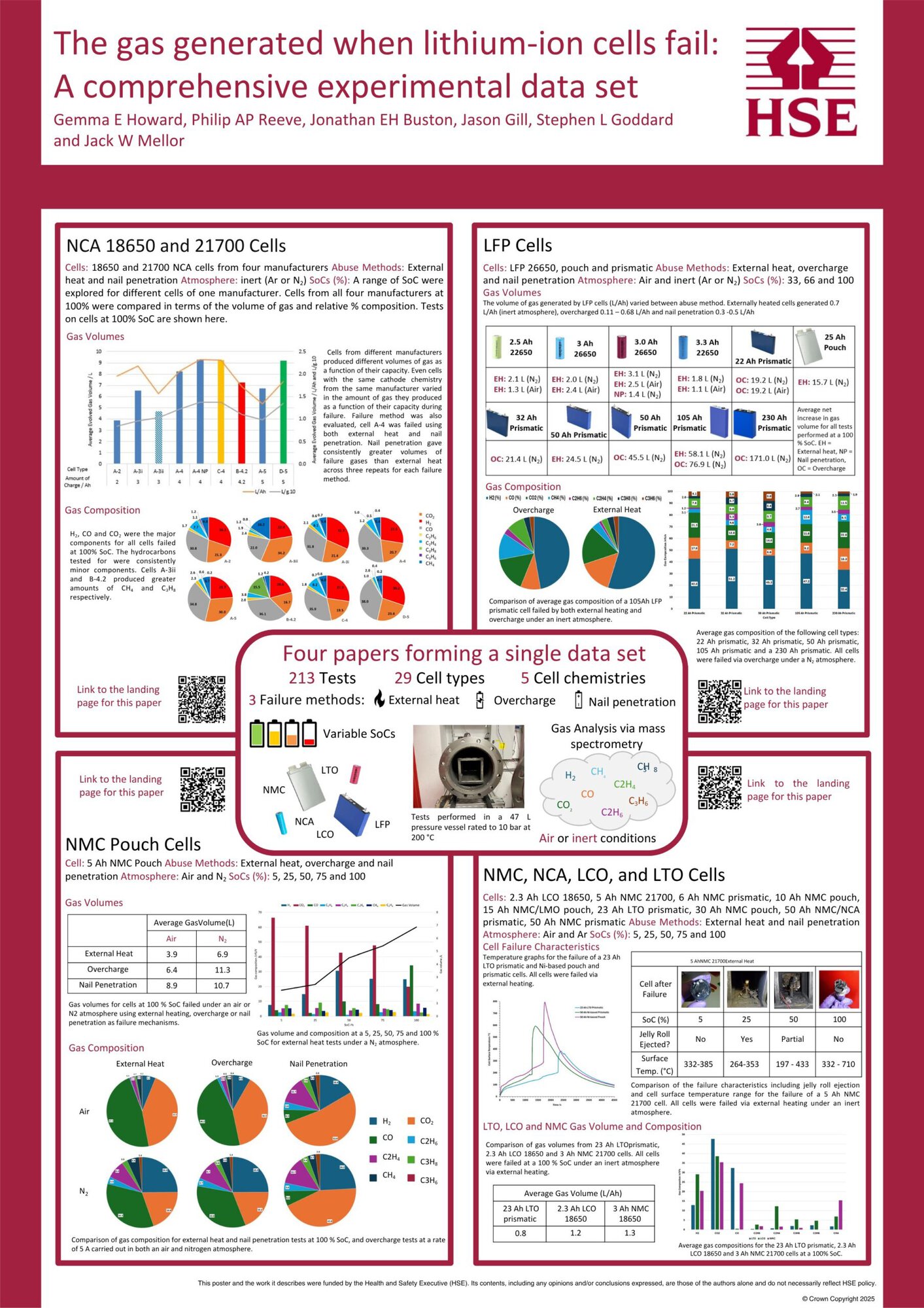
Figure 1 (right). HSE poster summarising a four-paper dataset of 213 lithium-ion cell failure tests.
5 Ah NMC Pouch Cells: Failure Mechanism and State-of-Charge Effects
The first paper, Comprehensive Study of the Gas Volume and Composition Generated by 5 Ah Nickel Manganese Cobalt Oxide (NMC) Li-Ion Pouch Cells Through Different Failure Mechanisms at Varying States of Charge, examined 5 Ah lithium nickel manganese cobalt oxide (NMC) pouch cells subjected to external heating, overcharge and nail penetration in both air and nitrogen atmospheres. At 100% SoC, the generated gas volume varied strongly with abuse method and atmosphere, with nitrogen tests generally producing higher gas volumes than air tests. H₂, CO₂ and CO were the dominant components across the failure modes, while higher H₂ and CO concentrations were observed under nitrogen, consistent with reduced combustion relative to air. Gas samples were collected from the pressure vessel into Tedlar bags and analysed using a Hiden Analytical HPR-20 TMS quadrupole mass spectrometer with a heated capillary inlet, with spectral data corrected for fragment overlap and converted into volume percentages using instrument sensitivity factors.
LFP Cells from 3–230 Ah: Gas Generation Across Cell Format and Abuse Mode
The second paper, Comprehensive Study of the Gas Volume and Composition Produced by Different 3–230 Ah Lithium Iron Phosphate (LFP) Cells Failed Using External Heat, Overcharge and Nail Penetration Under Air and Inert Atmospheres, extended the dataset to lithium iron phosphate (LFP) cylindrical, pouch and prismatic cells ranging from small 26650 formats to large 230 Ah prismatic cells. External heating under inert atmospheres at 100% SoC typically generated approximately 0.7–0.8 L/Ah of gas, while overcharge and nail penetration produced lower volumes, typically around 0.11–0.68 L/Ah and 0.3–0.5 L/Ah respectively. Despite these differences in volume, the gas composition remained broadly similar across test configurations, with H₂ a major constituent and CO₂, CO and light hydrocarbons also present. The Hiden HPR-20 TMS was used to analyse the collected post-failure gases over a 0–150 m/z range, quantifying the permanent gas fraction and enabling direct comparison across cell formats, capacities and abuse modes.
NCA Cells from Different Manufacturers: Cell-to-Cell Variability in Failure Gas
The third paper, Failure gas analysis of lithium–nickel–cobalt aluminium oxide cells from different manufacturers, investigated lithium nickel cobalt aluminium oxide (NCA) 18650 and 21700 cells sourced from four manufacturers. The study reported 69 failure tests, primarily using external heating with additional nail penetration testing, in inert nitrogen or argon atmospheres. At 100% SoC, gas generation ranged from 1.34 to 2.32 L/Ah across 2–5 Ah cells, showing that gas volume depends not only on state of charge or amount of charge, but also materially on the specific cell type and manufacturer. The main gas components were H₂, CO and CO₂, with mixed hydrocarbons present at lower concentrations. In this work, the HPR-20 TMS mass spectrometric approach provided the compositional resolution needed to compare the relative abundance of CO₂, CO, H₂, CH₄, C₂H₆, C₂H₄, C₃H₈ and C₃H₆ across different NCA cells, supporting the conclusion that safety-critical assessments should be based on the specific cell under consideration rather than generic chemistry-level assumptions.
Cell Chemistry, State of Charge and Abuse Method: Extending the Dataset to NMC, NCA, LCO and LTO Cells
The fourth paper, The Effects of Cell Chemistry, State of Charge, and Abuse Method on Gas Generation in Li-Ion Cell Failure, broadened the comparison to multiple chemistries and formats, including NMC, NMC/LMO, NMC/NCA, LCO and LTO cells in 18650, 21700, pouch and prismatic formats. For a 5 Ah NMC 21700 cell externally heated under inert conditions, gas volume increased from 1.8 L at 5% SoC to 8.3 L at 100% SoC, demonstrating a strong SoC dependence in absolute gas generation. Across larger Ni-based pouch and prismatic cells, external heating produced approximately 1.29–1.89 L/Ah, with H₂, CO and CO₂ again forming the major gas fraction. LTO cells generated lower gas volumes, around 0.8 L/Ah, and showed lower H₂ but higher CO₂ concentrations relative to Ni-based cells, while the LCO 18650 cell generated around 1.2 L/Ah. The Hiden Analytical HPR-20 TMS was central to this comparative dataset, analysing gas samples through a heated capillary inlet and applying quantitative mass spectral correction methods to deliver directly comparable gas composition data across cell chemistries, formats and failure mechanisms.
Paper References:
- Howard, G. E., Abbott, K. C., Buston, J. E. H., Gill, J., Goddard, S. L. and Howard, D. (2025) ‘Comprehensive Study of the Gas Volume and Composition Generated by 5 Ah Nickel Manganese Cobalt Oxide (NMC) Li-Ion Pouch Cells Through Different Failure Mechanisms at Varying States of Charge.’ Batteries. MDPI AG, 11(5) p. 197. DOI: 3390/batteries11050197.
- Howard, G. E., Buston, J. E. H., Gill, J., Goddard, S. L., Mellor, J. W. and Reeve, P. A. P. (2025) ‘Comprehensive Study of the Gas Volume and Composition Produced by Different 3–230 Ah Lithium Iron Phosphate (LFP) Cells Failed Using External Heat, Overcharge and Nail Penetration Under Air and Inert Atmospheres.’ Batteries. MDPI AG, 11(7) p. 267. DOI: 3390/batteries11070267.
- Howard, G. E., Buston, J. E. H., Gill, J., Goddard, S. L., Mellor, J. W. and Reeve, P. A. P. (2025) ‘The Effects of Cell Chemistry, State of Charge, and Abuse Method on Gas Generation in Li-Ion Cell Failure.’ Batteries. MDPI AG, 11(9) p. 320. DOI: 3390/batteries11090320.
- Reeve, P. A. P., Buston, J. E. H., Gill, J., Goddard, S. L., Howard, G. E. and Mellor, J. W. (2025) ‘Failure gas analysis of lithium–nickel–cobalt–aluminium oxide cells from different manufacturers.’ RSC Advances. Royal Society of Chemistry (RSC), 15(7) pp. 5084–5095. DOI: 1039/D4RA07884E.
