On the early Earth — during the Archean eon — the atmosphere contained very little freely available oxygen (O₂). Because of this, many of the chemical weathering processes we see today (which depend on oxygen) would have been far slower or entirely absent. The mineral pyrite (iron sulfide, FeS₂) is especially important in this context because, when it oxidizes, it releases sulfur and iron — both essential nutrients for life. Under modern, oxygen-rich conditions, pyrite oxidizes easily, but in the low-oxygen Archean world, it has been unclear how much oxidation could occur.
The research team explored a non-traditional pathway: that lightning in an oxygen-poor but nitrogen- and carbon-dioxide-rich atmosphere could produce nitrogen oxides (NOₓ) capable of oxidizing pyrite even without abundant O₂. In other words, lightning might have acted as a chemical engine driving pyrite oxidation on the early Earth, releasing sulfur, iron, and other nutrients locally.
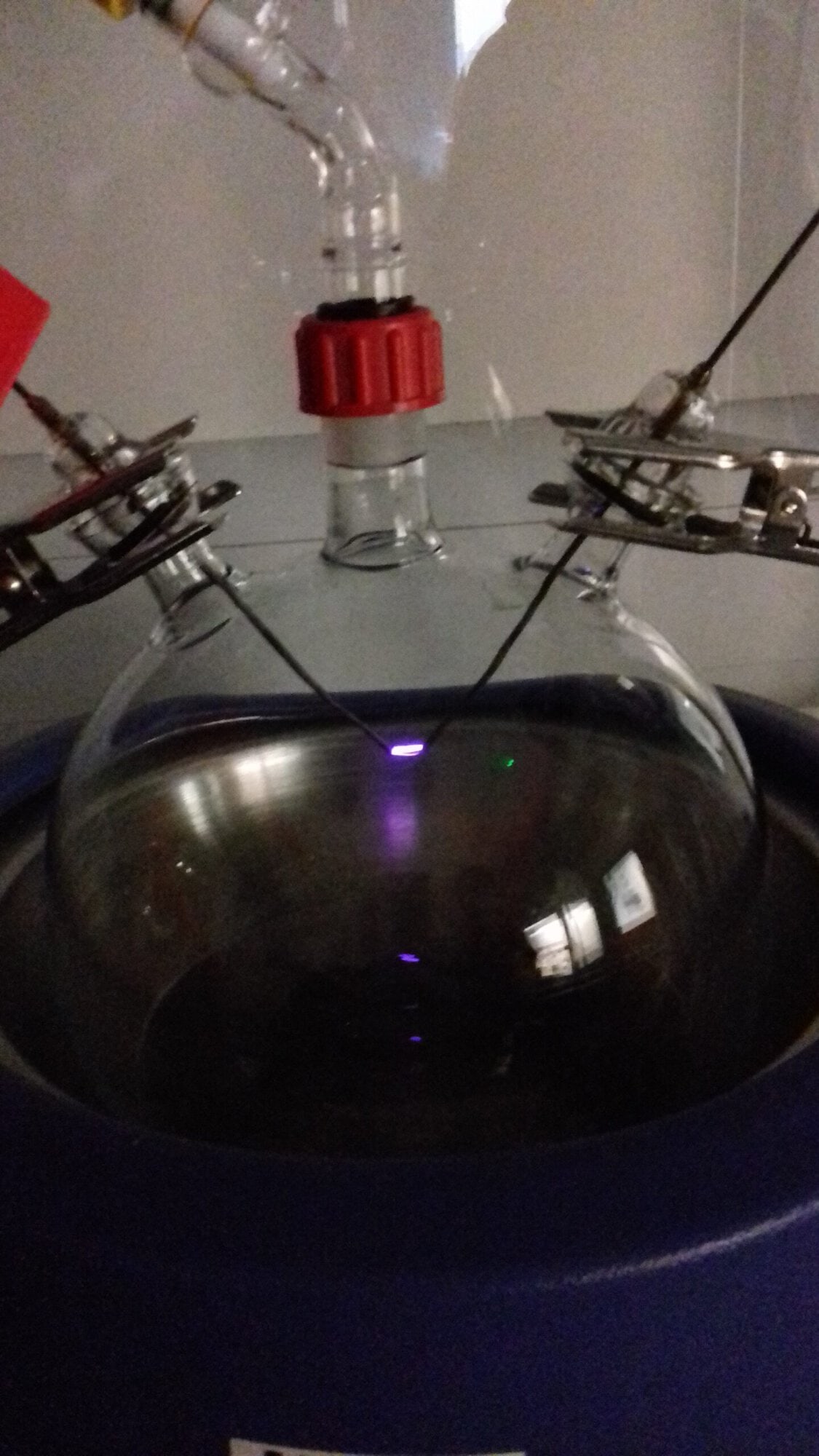
Figure 1. A laboratory spark-discharge set up containing pyrite powder and three different gas mixtures.
To test this idea, the team conducted laboratory spark-discharge experiments (mimicking lightning) using pyrite powder and three different gas mixtures:
- 80% N₂ with 20% CO₂ (an Archean-style atmosphere)
- 95% N₂ with 5% CO₂ (a lower-CO₂ scenario)
- Modern air (as a control)
During 30-minute runs, they measured how much nitric oxide (NO) was produced, as well as the levels of dissolved nitrate, nitrite, sulfate, and iron, along with changes in pH.
Key findings:
- The amount of nitrogen oxides (NOₓ) produced by the spark experiments increased with higher CO₂ (and O₂) levels — that is, the more CO₂ present, the more NOₓ was generated.
- Along with increased NOₓ production, they observed higher concentrations of dissolved iron and sulfate from the pyrite samples. This showed that the NOₓ formed by the lightning-like discharges was indeed oxidizing the pyrite, converting sulfide (S²⁻) to sulfate (SO₄²⁻) and releasing iron (Fe) into the solution.
- When the laboratory results were scaled up to global early Earth conditions, the researchers found that lightning-driven pyrite oxidation was likely a minorcontributor to global weathering. However, they concluded that in regions with frequent lightning — such as tropical storm belts — this process could have been locally significant, perhaps comparable to the limited oxygen-based weathering possible at that time.
- The effect was most pronounced under CO₂-rich conditions, implying that this mechanism would have been especially relevant when atmospheric CO₂ was high. This could apply not only to the early Earth but also to other planets with similar CO₂-rich, oxygen-poor atmospheres.
In simple terms: even though the early Earth lacked much free oxygen, lightning could have produced reactive nitrogen compounds that oxidized pyrite and released important nutrients such as iron and sulfur. While this process would not replace the dominant oxygen-driven weathering seen today, it might have created local “hotspots” of nutrient release long before the atmosphere became oxygen-rich.
The broader significance is twofold:
- It offers a plausible pathway for releasing bio-important nutrients under anoxic conditions, shedding light on possible nutrient sources for early life.
- It suggests that similar lightning-driven chemistry might operate on other planets with CO₂-rich atmospheres and frequent storms, such as early Mars or some exoplanets.
In conclusion, the research supports the idea that lightning-generated nitrogen oxides could oxidize pyrite under Archean-like conditions. While globally limited, this process could have been locally important — and provides new insight into how lightning may have shaped the early Earth’s surface chemistry and the habitability of other worlds.
Project Summary by: Dr. Eva Stueeken, University of St Andrews, St Katharine’s West, The Scores, St Andrews, KY16 9AX, Scotland.
Paper Reference: Long, A. L. S., Baidya, A. S. and Stüeken, E. E. (2024) ‘Lightning-Driven Pyrite Oxidation Under Archean Atmosphere Conditions.’ Astrobiology, 24(12) pp. 1208–1219. DOI: 10.1089/ast.2024.0074.
Hiden Product: ExQ (now known as QGA 2.0).