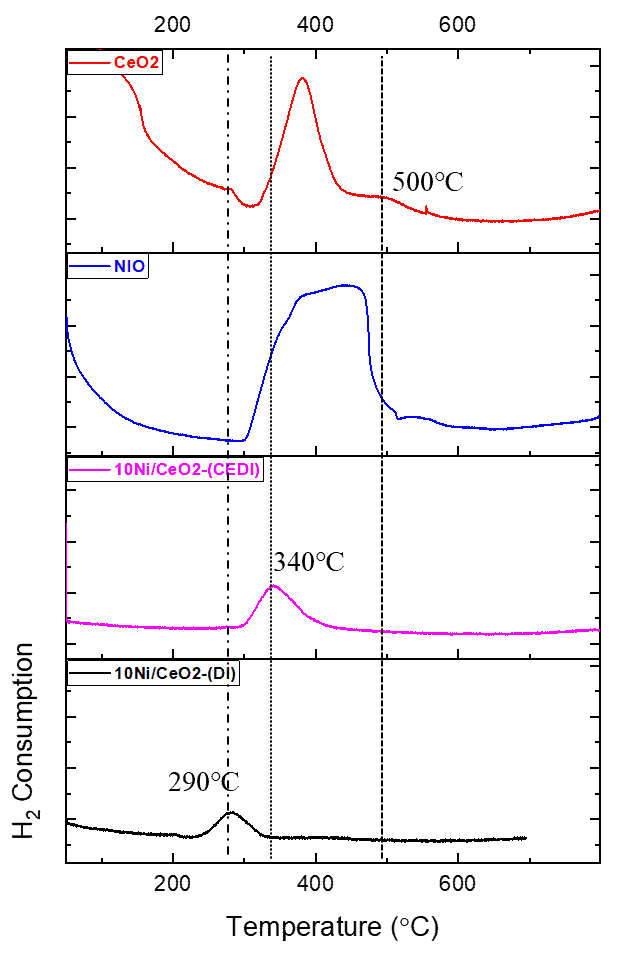
Figure 1. H2-TPR (temperature-programmed reduction) profiles for NiO, CeO2, and the 10Ni/CeO2-DI and 10Ni/CeO2-CEDI catalysts.

Figure 2 (left). O2– TPO profiles of 10Ni/CeO2-DI and 10Ni/CeO2-CEDI catalysts synthesised by DI and CEDI methods. The experimental conditions for these results include a model biogas feed ratio of CH4/CO2=1, GHSV of 7500 mL/h⋅gcat, and a reaction time of seven hours.
Figure 3 (right). CO2 conversion at temperatures 800 ̊C, 850 ̊C and 900 ̊C. The experimental conditions for these results include a model biogas feed ratio of CH4/CO2=1, a gas hourly space velocity (GHSV) of 7500 mL/h⋅gcat, and a reaction time of seven hours.
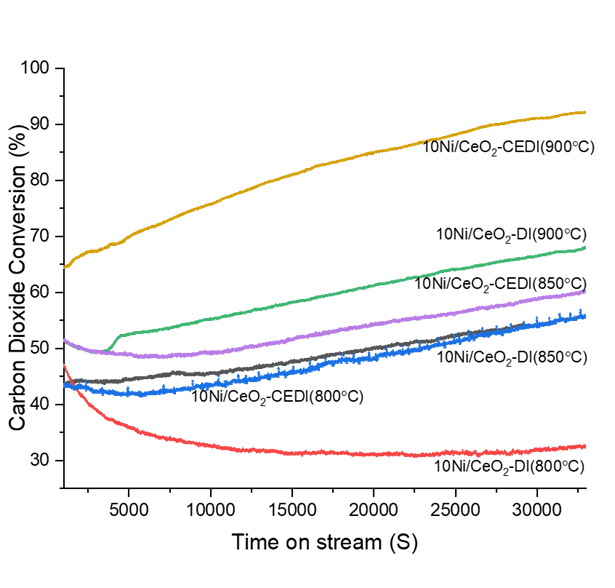
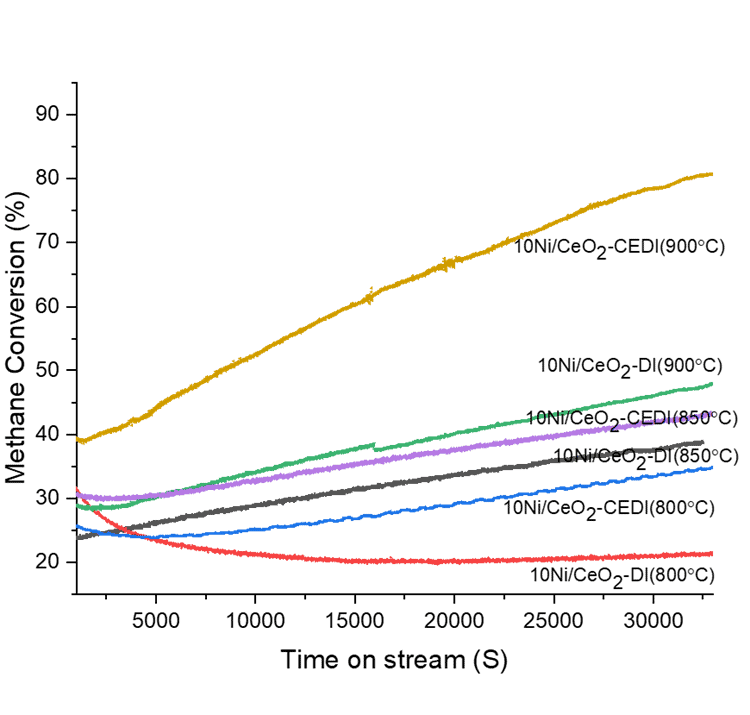
Figure 4 (left). CH4 conversion at temperatures 800 ̊C, 850 ̊C and 900 ̊C. The experimental conditions for these results include a model biogas feed ratio of CH4/CO2=1, a gas hourly space velocity (GHSV) of 7500 mL/h⋅gcat, and a reaction time of seven hours.
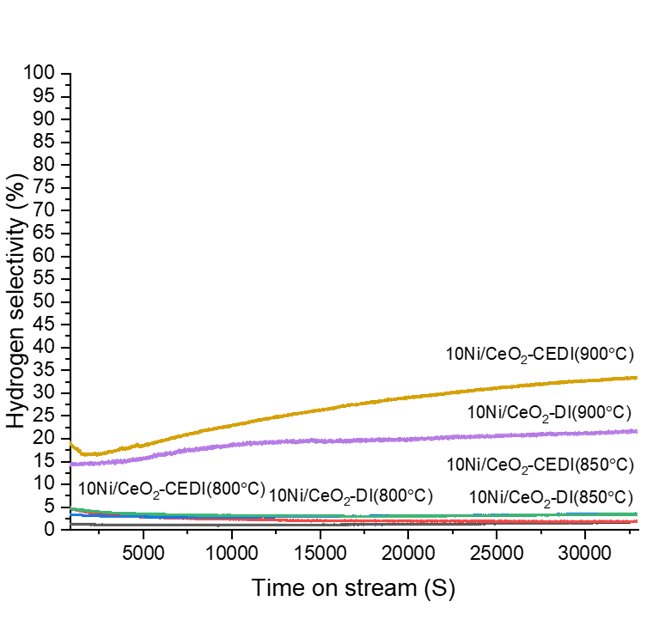
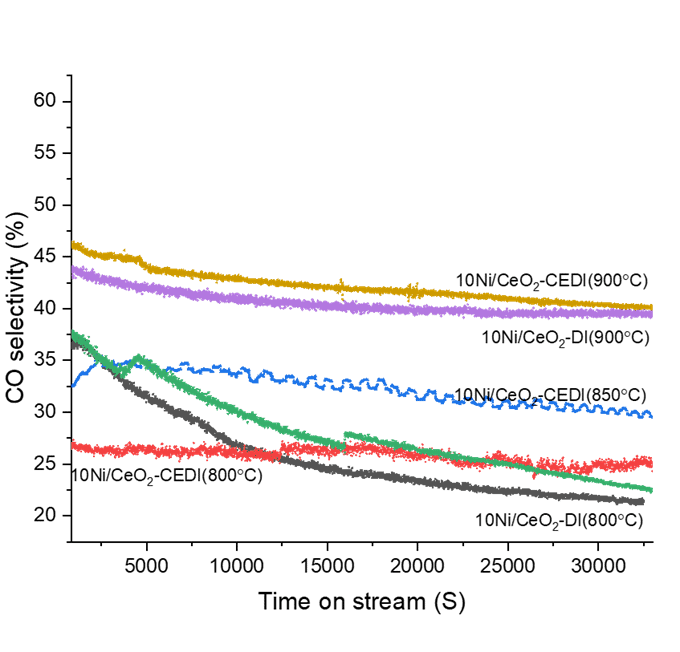
The experimental findings unequivocally demonstrated the effectiveness of the CEDI method in achieving the intended enhancement of electrostatic interactions between the nickel precursor and the ceria support. This improved interaction manifested in superior structural and electronic properties in the 10Ni/CeO2-CEDI catalyst. Specifically, the CEDI preparation led to a marked reduction in the average nickel nanoparticle size, achieving 3.33 nm, which is significantly smaller than the nanoparticle size observed in the control DI-prepared catalyst. This size reduction translated directly into a substantial enhancement in active metal dispersion, increasing from a mere 1.40% in the 10Ni/CeO2-DI catalyst to a high of 5.04% in the CEDI-prepared counterpart. Moreover, a stronger interaction between the metal and the support was evidenced by a discernible positive shift in the TPR reduction temperature that increased from 290℃ for the control catalyst to 340℃ for the CEDI-prepared catalyst. Collectively, these superior physicochemical attributes directly correlated with enhanced catalytic performance under biogas reforming conditions. The 10Ni/CeO2-CEDI catalyst exhibited both a higher biogas conversion efficiency and a substantial reduction in the rate of carbon deposition. These results validate the CEDI approach as an effective and promising technique for synthesising highly active and stable supported nickel catalysts for efficient syngas production via biogas dry reforming reaction.