
HPR-20 DLS for Ultra-High Resolution Gas Analysis
For further information and pricing, please get in touch with us.
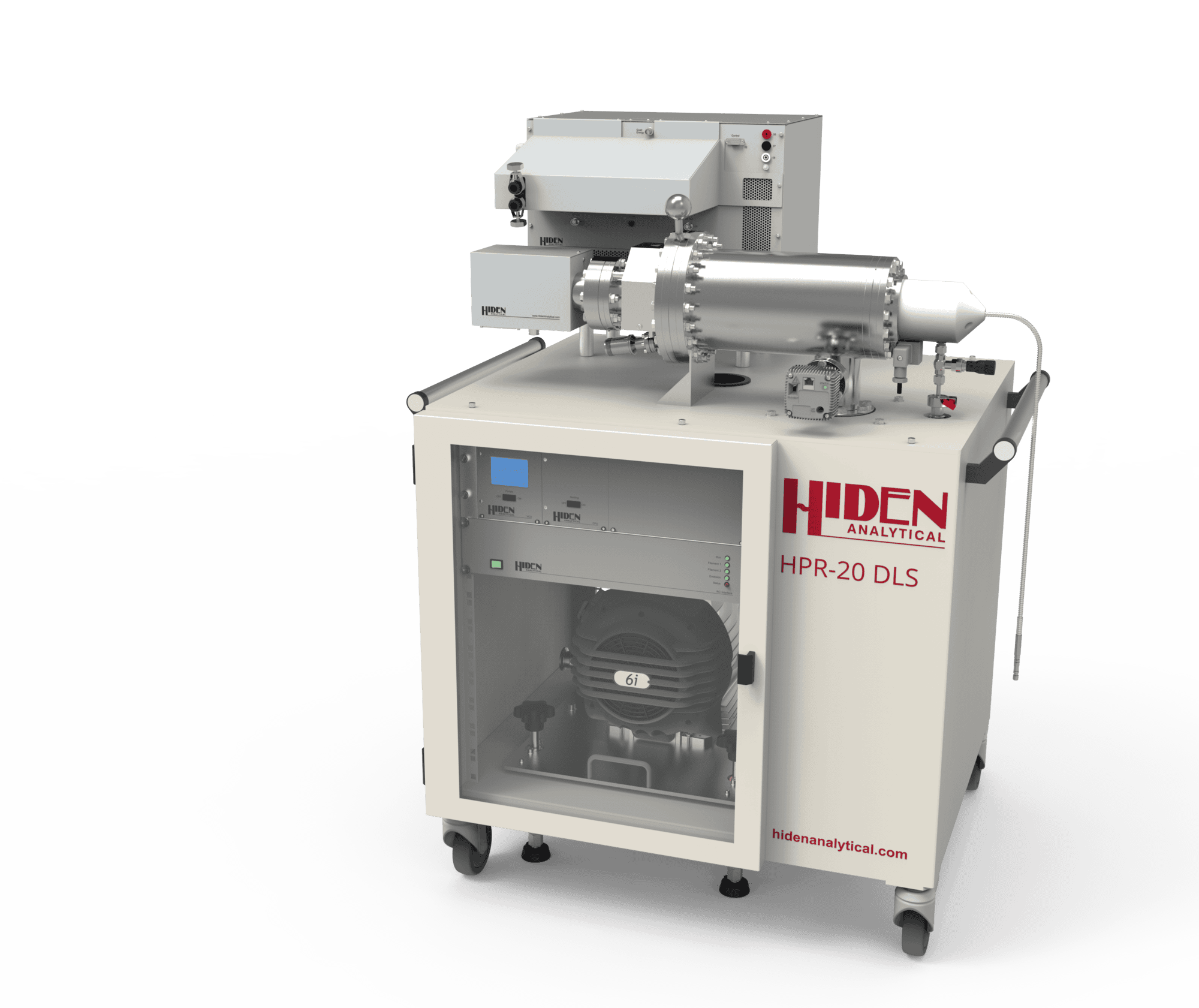
Hiden HPR-20 DLS is a continuous gas and vapour analysis system designed for high-resolution measurement of hydrogen isotopes, helium isotopes, and other isotopes with small mass separations. It combines a heated atmospheric-pressure sampling inlet with Hiden’s DLS-20 dual-zone quadrupole mass spectrometer.
Applications
The HPR-20 DLS continuously samples gases and vapours from sources at or near atmospheric pressure. A heated, quartz-lined Hiden QIC inlet transfers a small sample flow into the mass spectrometer, allowing changing gas compositions to be monitored over time.
Alternative inlet systems are available for suitable gas sources at pressures up to 30 bar. Pressurised gases require the appropriate Hiden sampling and pressure control arrangement and should not be connected directly to the standard inlet without suitable regulation.
At the centre of the system is the DLS-20 ultra-high-resolution quadrupole mass spectrometer. A quadrupole separates ions according to their mass-to-charge ratio. The DLS-20 uses a 20 mm-diameter mass filter and software-selectable operating zones to provide different combinations of mass range and resolving performance.
The two operating zones are:
- Zone H: Ultra-high-resolution operation for selected light-gas and isotope measurements up to 22.5 amu
- Zone 1: High-stability operation over a wider mass range up to 200 amu
The operating zone is selected through the instrument software. This allows the same DLS-20 analyser to resolve low-mass peaks with small mass separations in Zone H before returning to wider-range analysis in Zone 1.
The HPR-20 DLS is designed to address selected low-mass overlaps, including:
- Helium-4 and deuterium: ⁴He and D₂ both appear near nominal mass 4, but differ in exact mass by approximately 0.026 amu
- Deuterated water and neon: D₂O and the principal isotope of neon both appear near nominal mass 20, but differ by approximately 0.035 amu
- Helium-3 and hydrogen deuteride: ³He and HD both appear near nominal mass 3, but differ in exact mass by approximately 0.006 amu
Sensitivity and response
Hiden publishes DLS-20 sensitivity figures of:
- 1 ppm helium in deuterium
- 1 ppm deuterium in helium
- Detection of ³He in HD
These figures describe published DLS-20 performance under defined test conditions. Achievable performance in an installed system will also depend on calibration, background signals, inlet configuration, detector settings and the complete gas matrix.
The quartz-lined QIC sampling interface operates at temperatures up to 200°C. Hiden reports a response of less than 300 milliseconds to changes in concentration for most common gases and vapours, including water vapour.
The system is supplied with MASsoft Professional for mass-spectrometer control, acquisition, data processing and compatible external-device integration. Instrument communication is available through USB 2.0, RS-232 and Ethernet.
Key features of the HPR-20 DLS include:
- Instrument type: Continuous high-resolution gas and vapour analysis system
- Core analyser: Hiden DLS-20 quadrupole mass spectrometer
- Mass-filter diameter: 20 mm
- Mass-filter operation: Software-selectable Zone H and Zone 1 operating regions
- Zone H range: Ultra-high-resolution operation up to 22.5 amu
- Zone 1 range: High-stability operation up to 200 amu
- Published real-time mass separation: 0.006 amu
- Published sensitivity: 1 ppm He in D₂ and 1 ppm D₂ in He
- Additional published capability: Detection of ³He in HD
- Standard sample type: Continuously flowing gases and vapours
- Standard sample-source pressure: At or near atmospheric pressure
- Optional source-pressure capability: Suitable sources up to 30 bar with the appropriate inlet and pressure-control system
- Standard inlet: Quartz-lined Hiden QIC sampling interface
- Maximum published QIC temperature: 200°C
- Published QIC response: Less than 300 ms for most common gases and vapours
- Detector: Pulse ion-counting electron multiplier
- Published detector dynamic range: Seven continuous decades
- Maximum published acquisition rate: Up to 1,000 measurements per second*
- Specialist scanning mode: Dynamic multi-mode scanning for electron-attachment ionisation studies of suitable electronegative gases
- Software: MASsoft Professional
- Communication: USB 2.0, RS-232 and Ethernet
- External integration: Compatible external signals and devices can be recorded or controlled through the available instrument interfaces
*Refers to individual measurement points acquired by the mass spectrometer
The system is supplied with MASsoft Professional Edition software.
MASsoft Professional software allows for control of the instrument via USB 2.0, RS232 or Ethernet. Provides comprehensive I/O for data output and for reading data from external devices for integration and display with mass spectrometer data.
