
Radioactive isotopes are central to modern nuclear medicine. They are used both for diagnosis, where their radiation is detected externally to image biological function, and for therapy, where the emitted particles deliver a localised radiation dose to diseased tissue. Examples include:
- Technetium-99m for SPECT imaging
- Iodine-131 for thyroid disease
- Lutetium-177 for targeted radionuclide therapy
- Samarium-153 for bone pain palliation
- Holmium-166 for liver radioembolisation
- Yttrium-90 for therapeutic microspheres
In each case, the clinical value of the isotope depends on a balance between radiation type, energy, chemistry, biological targeting, and physical half-life.
The importance of half-life
The half-life is particularly important. It must be long enough for production, chemical processing, transport, radiopharmaceutical preparation, and administration, but short enough to avoid unnecessary patient dose and long-lived waste.
Technetium-99m, for example, has a half-life of about 6 hours and is supplied from molybdenum-99 generators, with molybdenum-99 having a half-life of about 66 hours. Lutetium-177 has a half-life of about 6.65 days, which is well-matched to targeted therapy logistics. Iodine-131 has a half-life of about 8 days, samarium-153 about 46 hours, holmium-166 about 27 hours, and yttrium-90 about 64 hours. These values are not incidental; they are a direct consequence of the selected nuclear reaction and the isotope produced.
Reactor-produced medical radionuclides
Many reactor-produced medical radionuclides are made by neutron irradiation of stable isotope targets. In the simplest case, a stable isotope captures a neutron to form a radioactive isotope:
stable target isotope + neutron → radioactive product isotope
The activity produced depends on the number of target atoms, neutron flux, neutron-capture cross-section, irradiation time, and product half-life. For this reason, choosing the correct stable isotope is critical. If the target contains too little of the desired isotope, the yield is reduced. If neighbouring stable isotopes are present, they may also be activated, producing unwanted radionuclidic impurities. These impurities can reduce specific activity, complicate radiochemical purification, alter dosimetry, and increase radioactive waste.
Example: lutetium-77
A clear example is lutetium-177. It may be produced directly by neutron irradiation of enriched lutetium-176, giving carrier-added lutetium-177, or indirectly by irradiation of enriched ytterbium-176 to form ytterbium-177, which decays to no-carrier-added lutetium-177.
The indirect route requires chemical separation of lutetium from ytterbium after irradiation, but can provide very high specific activity because stable lutetium carrier is not introduced. The isotopic composition of the starting target therefore controls both yield and product purity.
Example: molybdenum-99
Molybdenum-99 provides another example. Although much commercial molybdenum-99 has historically been produced by fission of uranium-235, neutron activation of enriched molybdenum-98 is also used or considered for generator production. The enrichment of molybdenum-98 directly affects the achievable molybdenum-99 activity and the level of co-produced molybdenum isotopes.
Similarly, samarium-153 is produced from samarium-152, holmium-166 from holmium-165, and yttrium-90 from yttrium-89. In some cases, such as natural holmium and yttrium, the element is effectively monoisotopic; in others, such as molybdenum, samarium, ytterbium, and lutetium, enrichment of the correct isotope is essential.
Enriching stable isotopes
Stable isotopes for medical isotope production are enriched using a range of technologies. Electromagnetic isotope separation can provide high enrichment for many elements and is suitable for specialist quantities. Gas centrifugation can be used where a suitable volatile compound is available and can provide larger-scale production. Cryogenic distillation, thermal diffusion, chemical exchange, ion exchange, and laser-based methods may also be used depending on the element and chemical form. Laser isotope separation is of particular interest where isotope-selective excitation or ionisation can enrich material in a spatially or temporally structured deposition process.
After irradiation, the radioactive product usually requires radiochemical purification. This may include target:
- Dissolution
- Precipitation
- Solvent extraction
- Ion-exchange chromatography
- Extraction chromatography
- Generator separation
- Other hot-cell processes
These steps are designed to isolate the required radionuclide from the target material, activation products and chemical impurities. However, before irradiation, during process development and after enrichment, it is often necessary to measure the stable isotope ratio of the solid target material itself. This is where Secondary Ion Mass Spectrometry (SIMS) offers a distinctive analytical advantage.
The role of Secondary Ion Mass Spectrometry (SIMS)
SIMS measures isotopic composition directly from the solid surface by sputtering material with a focused primary ion beam and mass-analysing the emitted secondary ions. Only a very small amount of material is consumed, often from a defined region of a few micrometres to hundreds of micrometres across. Unlike many bulk isotope-ratio methods, SIMS does not require dissolution of the sample in acid. This is valuable when the target material is expensive, scarce, difficult to dissolve, chemically hazardous, radioactive, or needed for subsequent use.
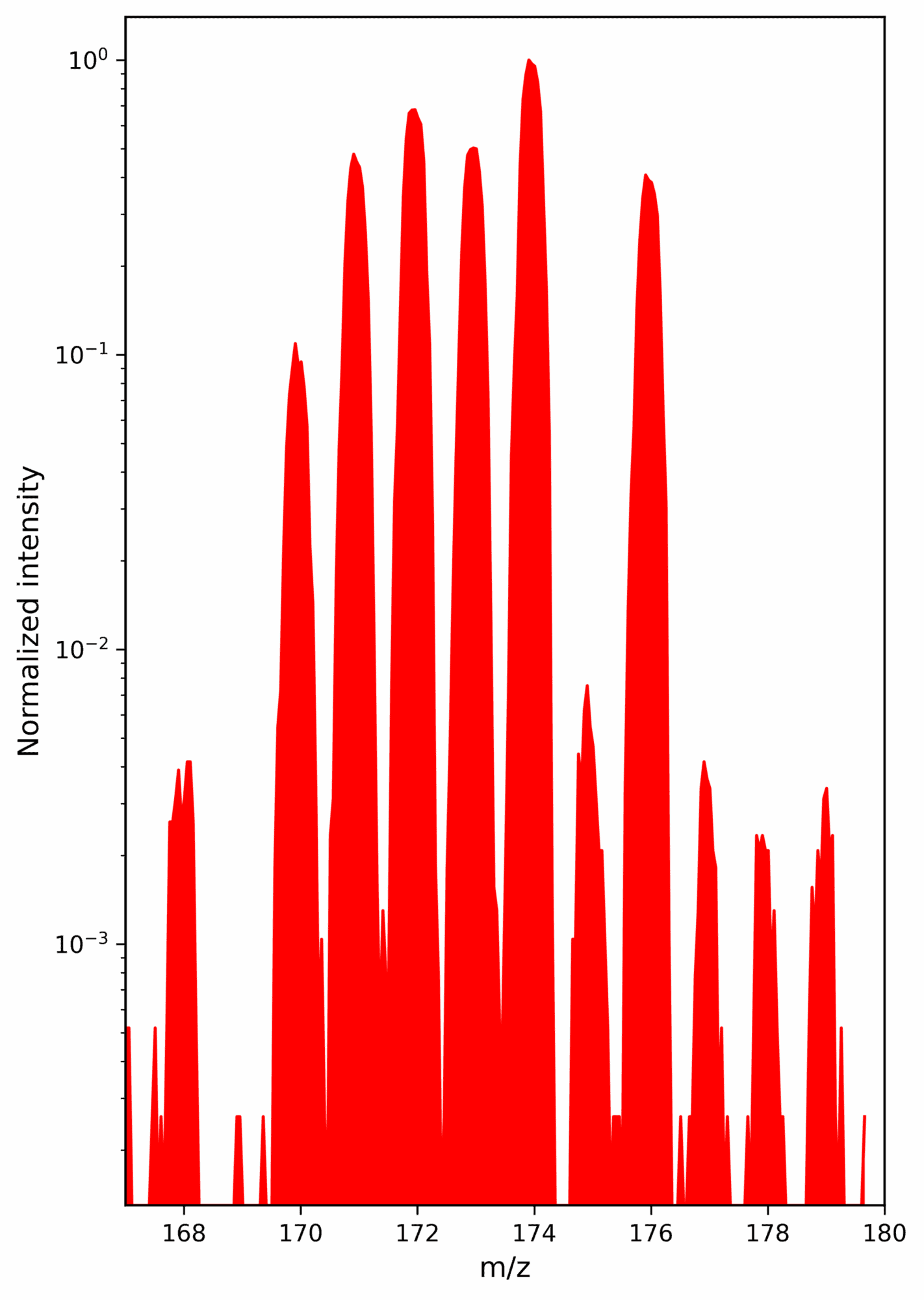
The mass spectrum shows the Yb isotopes normalised to the m/z=174 peak. Note that approximately 1ng of material is taken from the solid sample to make this measurement.
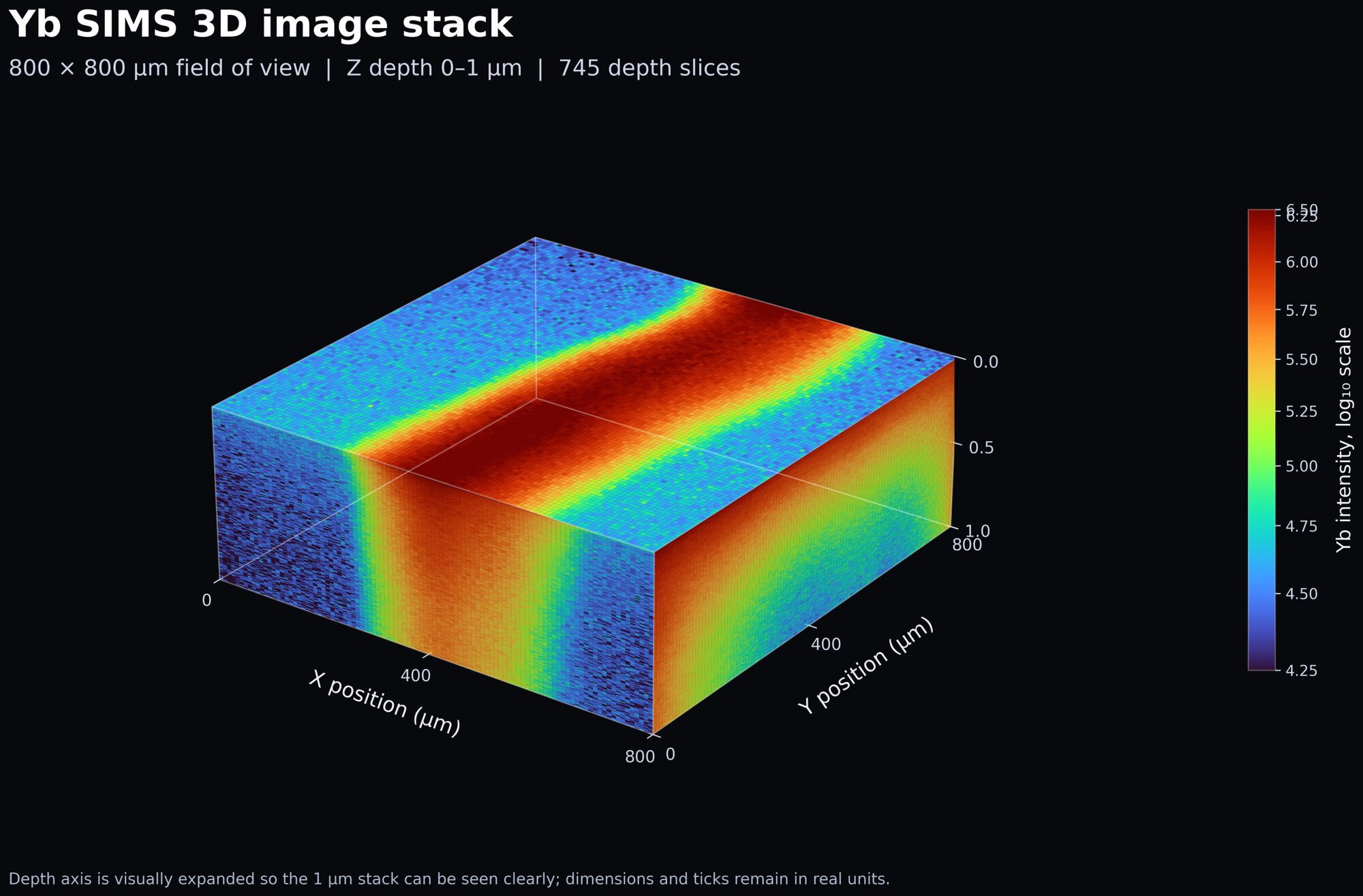
The 3D image shows a 200 µm wide line of Yb 174 deposited on a stainless-steel substrate. The measurement area is 800×800 µm and the total depth is 1 µm.
The most important advantage of SIMS in enriched-isotope target development is that it preserves spatial information. A conventional solution measurement gives an average isotope ratio for the dissolved portion of material. That can be highly accurate for a homogeneous bulk sample, but it cannot show whether enrichment varies through a layer, across a particle, across a deposited film, or through a collected laser-enrichment product. SIMS can generate lateral isotope maps and depth profiles, allowing isotope ratio to be measured as a function of position and sputtered depth.
This is especially relevant to deposited or collected enrichment products. In laser enrichment, plasma, vapour or particle collection processes, the material may be deposited over time onto a surface. The depth through the deposit can therefore represent a time sequence during the enrichment run. SIMS depth profiling can measure whether the isotope ratio remains constant through the deposit, whether enrichment drifts with process time, or whether transient start-up and shut-down periods produce off-specification material. This depth-resolved measurement is difficult to obtain from a bulk dissolution method without physically sectioning or sequentially removing the deposit.
For isotope-ratio work, SIMS can compare the intensities of selected isotopes of the same element, such as molybdenum isotopes, ytterbium isotopes, lutetium isotopes, or samarium isotopes. SIMS provides quantitative isotope ratios and qualitative enrichment verification. It can also identify local contamination, substrate mixing, surface oxidation, diffusion effects, and interfacial changes that may affect target performance.
By combining high mass selectivity, small sample consumption and depth-resolved isotope analysis, SIMS can directly answer questions that are central to medical isotope production:
- Was the correct stable isotope enriched?
- Is the enrichment homogeneous?
- Does the isotope ratio change through the deposited layer?
- Are unwanted isotopes or contaminants present?
- Is the target material suitable for efficient neutron irradiation to produce the required activity and half-life?
These capabilities make SIMS an especially strong technique for characterising enriched solid isotope targets before they enter the radioisotope production chain.
To discuss how SIMS can support isotope ratio measurement, depth profiling and contamination analysis in enriched medical isotope target development, contact us. Our surface analysis specialists can help identify the most suitable SIMS approach for characterising scarce, high-value or process-critical isotope materials.
Learn more about our range of instruments for surface analysis here.
