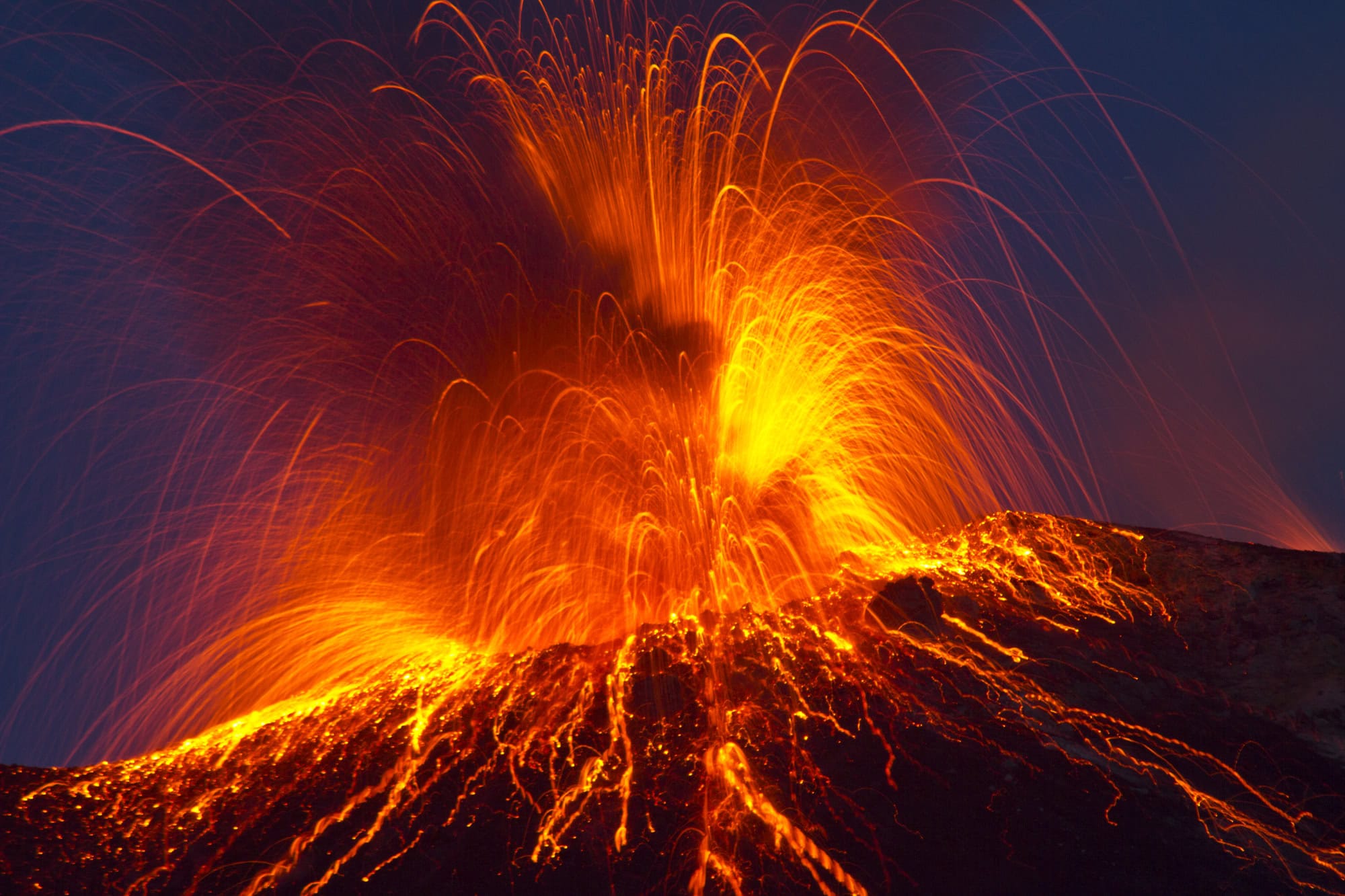
Mass Spectrometry for Volcanic Research
Volcanic systems are chemically dynamic, spatially variable, and often difficult to access safely. For researchers and monitoring teams, obtaining reliable compositional data quickly is essential for understanding degassing behaviour, interpreting magmatic and hydrothermal processes, and supporting hazard assessment workflows.
Mass spectrometry for volcanic research enables real-time volcanic gas analysis with high sensitivity and multi-species detection. By measuring key gases such as CO₂, SO₂, H₂S, H₂, CO and H₂O, quadrupole mass spectrometry supports time-resolved interpretation of changing emissions in active volcanic environments.
Portable systems are particularly valuable in field campaigns, where rapid analytical feedback can improve sampling decisions and help capture transient gas-composition changes that may be missed by delayed, laboratory-only workflows.
Within volcanic research workflows, mass spectrometry is typically used as part of a broader measurement strategy. In field campaigns, portable quadrupole MS can provide time-resolved compositional data and rapid analytical feedback, while researchers may combine these measurements with site-specific sampling protocols, calibration routines, and complementary methods depending on the study objective and environmental conditions
Why Mass Spectrometry is Used in Volcanic Research
Volcanic gas composition is one of the most informative indicators of subsurface activity. Changes in gas chemistry can help researchers assess evolving volcanic conditions and better understand the physical and geochemical processes driving emissions.
Mass spectrometry supports volcanic research by enabling:
-
Rapid compositional analysis of complex gas mixtures
-
Sensitive detection of key reactive and major volcanic gases
-
Multi-species measurement in a single analytical workflow
-
Time-resolved datasets for field campaigns and monitoring studies
-
Quantitative interpretation of degassing and geochemical evolution
This makes mass spectrometry a strong analytical approach for both volcanic process research and applied environmental and monitoring investigations.
Real-Time Volcanic Gas Analysis in Dynamic Field Environments
Volcanic emissions can change rapidly due to shifts in vent activity, gas transport pathways, atmospheric dilution, or subsurface process evolution. In these conditions, real-time data is critical.
What real-time monitoring improves
Mass spectrometry-based volcanic gas monitoring can support:
-
Faster recognition of composition changes during field measurements
-
Better time resolution for dynamic degassing studies
-
Improved interpretation of short-duration events
-
More informed sampling strategy adjustments on-site
-
Stronger datasets for subsequent geochemical analysis
For volcanic field campaigns, this can significantly improve the quality and interpretability of measured gas data.
Key Volcanic Gases Commonly Measured by Mass Spectrometry
In volcanic research workflows, commonly monitored species include:
CO₂ (carbon dioxide)
A major volcanic gas used in degassing studies and plume composition analysis.
SO₂ (sulfur dioxide)
A key species for tracking volcanic emissions and changes in sulfur-rich degassing.
H₂S (hydrogen sulfide)
Important for interpreting sulfur chemistry and hydrothermal influence.
H₂ (hydrogen)
Useful in assessing reactive gas chemistry and volcanic and hydrothermal processes.
CO (carbon monoxide)
Can provide insight into redox-related gas chemistry and reaction processes.
H₂O (water vapour)
A dominant volcanic volatile and an important context variable in gas mixtures.
What Mass Spectrometry Can Reveal About Volcanic Processes
Mass spectrometry does not just identify which gases are present — it helps researchers build a clearer picture of how volcanic systems are behaving over time.
Degassing behaviour
Time-resolved gas composition data can support interpretation of changing degassing patterns and emission behaviour.
Magmatic and hydrothermal interactions
Reactive gases (such as H₂ and CO) measured alongside major species can improve interpretation of hydrothermal activity and subsurface gas processes.
Geochemical evolution across a campaign
Repeated measurements help establish trends and variability in volcanic emissions across locations, time windows, or activity states.
Gas-water and environmental interactions
In broader volcanic and environmental studies, mass spectrometry can support analysis of volcanic gas, water, and sediment-related measurements.
Proven Performance for Volcanic Research
Mass spectrometry is well suited to volcanic research where sensitivity, speed, and multi-species capability are all important.
High sensitivity and selectivity
Mass spectrometry supports detection and quantification of key volcanic gases in complex mixtures, helping researchers produce robust compositional datasets.
Real-time insight in dynamic environments
Rapid composition monitoring helps capture transient changes in emissions during field studies and observation campaigns.
Applied volcanic field research support
Mass spectrometry can support quantitative volcanic studies by tracking major and reactive species relevant to degassing, hydrothermal activity, and geochemical interpretation.
Hiden Analytical Solutions for Volcanic Gas, Water and Sediment Analysis
Hiden Analytical supports this area through its Volcanic Gas, Water and Sediment Analysis application page, which outlines direct real-time analysis workflows in field and laboratory contexts and highlights relevant instrument solutions.
Explore the application page: https://hiden.nearly.live/applications/environmental/volcanic-gas-water-and-sediment-analysis/
pQA – Portable Quadrupole Analyser for Field-Based Studies
The pQA Portable Quadrupole Analyser is a Hiden portable quadrupole mass spectrometer designed for field and environmental measurements. This makes it highly relevant to volcanic and environmental workflows where portable, on-site analysis and time-resolved data collection are important.
Explore the pQA product page: https://hiden.nearly.live/products/gas-analysis/pqa-portable-quadrupole-analyser/
Why the pQA is relevant to volcanic research workflows
-
Portable format for field deployment
-
Quadrupole MS-based multi-species gas analysis
-
Suitable for real-time analytical measurements
-
Useful for time-resolved composition studies
-
Relevant to broader environmental gas, water and sediment investigations
Typical Volcanic Research Applications Supported by Mass Spectrometry
Mass spectrometry can support a broad range of volcanic and volcanology-adjacent investigations, including:
-
Volcanic plume composition studies
-
Active vent gas analysis
-
Degassing process characterisation
-
Hydrothermal system investigations
-
Gas-water interaction studies
-
Volcanic sediment or environmental sample studies (with suitable interfaces and workflows)
How Portable Mass Spectrometry Improves Volcanic Field Campaigns
Portable quadrupole mass spectrometry can improve volcanic fieldwork by reducing the delay between sampling and interpretation. Instead of relying only on post-campaign laboratory analysis, researchers can generate analytical feedback on-site, allowing them to:
-
Prioritise sampling locations in real time
-
Repeat measurements when anomalies are observed
-
Capture short-timescale variability
-
Improve contextual interpretation during campaigns
-
Build stronger, more complete datasets for later analysis
For teams working in rapidly changing volcanic environments, this can be a significant practical advantage.
Practical Considerations for Volcanic Field Measurements
When evaluating mass spectrometry for volcanic research, it is important to consider the measurement workflow as well as the instrument itself. Data quality in volcanic field environments depends on factors such as sampling configuration, gas composition, and site conditions.
-
Sampling interface and line configuration can affect response time, stability, and data quality.
-
Moisture and reactive species may require appropriate sampling design and method optimisation.
-
Calibration strategy should be aligned with the study objective (e.g. trend monitoring vs quantitative comparison).
-
Field conditions (access, power, safety, and environmental variability) influence deployment planning and measurement workflow.
-
Complementary measurements may still be used alongside mass spectrometry depending on the research question and monitoring approach.
Explore Hiden’s Volcanic Analysis Capabilities
To see how Hiden frames this application area in practice, visit the Volcanic Gas, Water and Sediment Analysis application page for an overview of the workflow and related instrumentation: https://hiden.nearly.live/applications/environmental/volcanic-gas-water-and-sediment-analysis/
Explore the pQA Portable Quadrupole Analyser
For field-based gas analysis and environmental measurement workflows, the pQA Portable Quadrupole Analyser product page provides a direct overview of the portable platform and its relevance to on-site studies:
https://hiden.nearly.live/products/gas-analysis/pqa-portable-quadrupole-analyser/
Speak to an Applications Specialist
If you are planning a volcanic field campaign or evaluating mass spectrometry for volcanic gas, water, or sediment studies, you can contact Hiden Analytical to discuss a suitable analytical configuration:
https://hiden.nearly.live/contact/
Frequently Asked Questions
What is mass spectrometry used for in volcanic research?
Mass spectrometry is used in volcanic research to measure and quantify volcanic gases (such as CO₂, SO₂, H₂S, H₂, CO and H₂O), helping researchers interpret degassing behaviour, geochemical changes, and volcanic system processes.
Why is real-time volcanic gas analysis important?
Real-time volcanic gas analysis helps researchers capture transient changes in gas composition during field campaigns, improving time-resolved datasets and on-site interpretation in dynamic volcanic environments.
Which volcanic gases can be measured with mass spectrometry?
Commonly measured gases include CO₂, SO₂, H₂S, H₂, CO and H₂O, depending on the analytical setup and application workflow.
Why use a portable quadrupole mass spectrometer for volcanic fieldwork?
Portable quadrupole mass spectrometers combine field deployability with sensitive, multi-species gas analysis, making them useful for volcanic studies where fast analytical feedback and time-resolved measurements are required.
Conclusion
Mass spectrometry is a valuable analytical tool for volcanic research because it combines sensitive gas detection, multi-species capability, and real-time measurement potential in workflows that support both scientific investigation and applied monitoring. For volcanic field campaigns and environmental studies, portable quadrupole mass spectrometry can provide the time-resolved compositional insight needed to better interpret degassing behaviour and changing volcanic conditions.
For researchers exploring volcanic gas, water, and sediment analysis, Hiden Analytical’s environmental mass spectrometry solutions — including the pQA Portable Quadrupole Analyser — provide a practical route to field-relevant, high-quality measurement workflows.