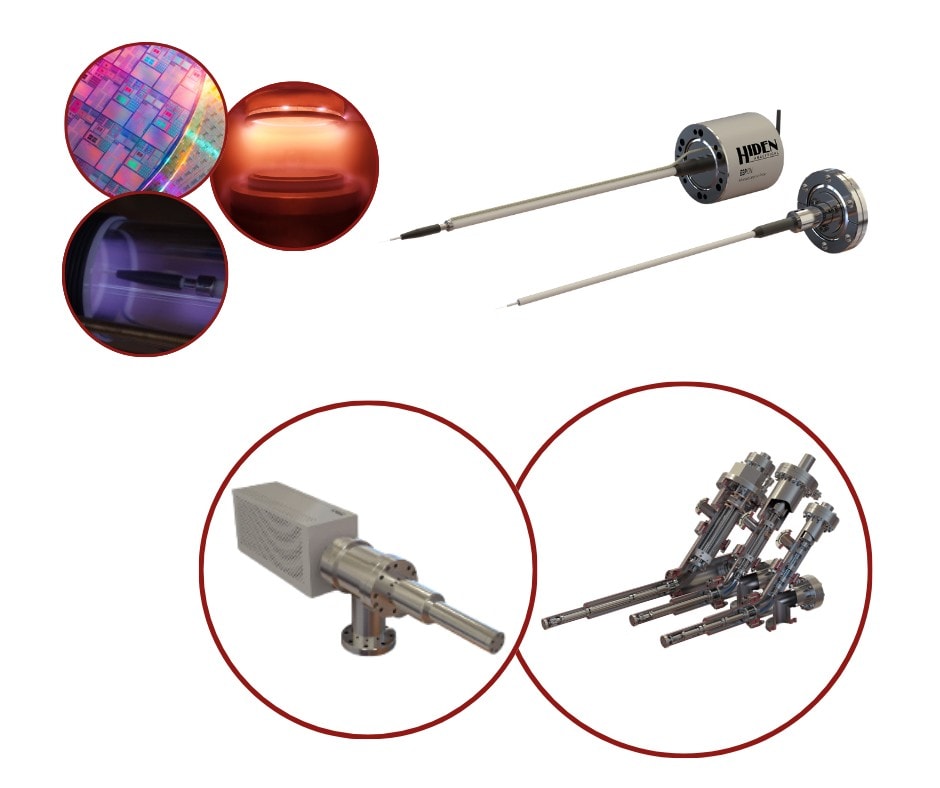
Sam, for scientists working in plasma processing every day, define “plasma characterisation”?
For scientists working in plasma processing, plasma characterisation is about understanding what the plasma is doing and what it produces.
That means measuring the key parameters: electron behaviour, the species present, and how ions and radicals interact with surfaces in terms of energy and flux.
It’s about linking plasma physics and chemistry directly to process outcomes, so you can move from trial-and-error to controlled, reproducible optimisation.
Why has that level of characterisation become so important in thin films, plasma and surface engineering?
It’s become important because the processes themselves have become much more demanding. In thin films, plasma, and surface engineering, small changes in plasma conditions can have a big impact on properties like film structure, stress, composition, or etch profile.
At the same time, the plasmas are more complex, multi-component chemistries, pulsed operation, tighter process windows, so you can’t rely on simple correlations anymore.
That means you need detailed characterisation to understand what’s driving the process at a mechanistic level, as well as observing the outcome. Without that, optimisation becomes slow and unpredictable. With it, you can tune processes more precisely and achieve consistent, reproducible results.
When you start characterising a plasma, which measurements matter first?
The first step is usually to establish the basic plasma state, so electron temperature, electron density, and plasma potential. Those set the overall behaviour of the discharge and give you a baseline to work from.
From there, the focus moves to species: which ions, neutrals, and radicals are present, and in what relative amounts, because that defines the chemistry of the process.
The next critical piece is how those species interact with the surface, so ion energy distributions and flux, which directly control etch rates and film growth.
So, in practice, it’s a progression from plasma parameters, to species, to energy and flux at the surface, with each layer adding more detail to how the process is actually working.
Where does a Langmuir Probe add the most value?
Langmuir probes add the most value when you want direct access to the fundamental plasma parameters, such as electron temperature, density, and plasma potential. Those are the quantities that set the overall behaviour of the discharge.
They’re particularly useful in low-pressure plasmas and in research or development environments where you want spatially resolved measurements, or to understand how the plasma responds to changes in power, pressure, or gas composition.
Systems like the ESPion take that a step further by providing a complete, integrated setup, so the probe design, positioning, data acquisition, and analysis are all handled in a consistent and repeatable way.
While probes don’t tell you everything about the chemistry, they’re still one of the most direct and effective ways to understand the underlying plasma state.
Radio Frequency (RF) and Inductively Coupled Plasmas (ICP) are notoriously challenging for probe work. How does Hiden support this?
You’re absolutely right, RF and ICP plasmas can make Langmuir probe measurements quite difficult because of the RF fluctuations coupling onto the probe and distorting the I–V curve.
The way we address that is through passive RF compensation built directly into the probe design. We use a tuned compensation electrode and filtering network that effectively cancels out the RF component at the probe tip, so what you’re measuring is much closer to the true plasma potential rather than the oscillating signal.
The advantage of doing this passively is that it’s inherently stable and doesn’t rely on active electronics or complex tuning during operation. It gives you clean, reliable I–V characteristics even in quite aggressive RF or ICP environments, so you can confidently extract parameters like electron temperature and density without the measurement being dominated by RF interference.
How are mass and energy analysers used?
They are used to sample particles directly from a plasma and measure both what they are and how energetic they are. You immerse the sampling orifice into the plasma, use the quadrupole to identify the species, and then measure their energy distributions with the energy analyser.
That’s really important because it enables you to measure how hard they’re hitting the surface. That energy and flux directly affect things like etch rates, film quality, and surface modification, so it gives you a much more complete picture for optimising the process.
How would you explain the difference between an EQP and a PSM?
They offer broadly similar capabilities but with some key differences related to performance and chamber compatibility. They are both advanced plasma sampling mass spectrometers with differentially pumped manifolds, high-sensitivity triple-filter quadrupole mass filters, and integrated energy analysers. Both provide mass and energy analysis of ions, neutrals and radicals.
The PSM is physically smaller and more compact owing to its Bessel box energy filter so can be more easily integrated onto chambers with limited external space. However, this design means that it’s insertion into the chamber is short and fixed, so where more flexibility is required, the EQP is the better choice since it can have a range of insertions between 214mm and 750mm.
The EQP also has a slightly higher transmission due to it’s 45° sector energy analyser giving it higher sensitivity and it can be fitted with larger quadrupole rods when greater mass resolution is required. This makes the EQP more suitable for high performance applications.
HiPIMS is a good example of where time resolution matters. How are HiPIMS used for plasma characterisation?
HiPIMS is a great example of where time-averaged data can completely hide the physics that actually matters. The plasma is pulsed, very high density, and the ion population evolves rapidly over each pulse.
Plasma characterisation there really has to be time-resolved. Across plasma systems, whether that’s mass spectrometry or probe-based diagnostics, you’re looking at parameters as a function of time through the pulse. Techniques like multi-channel scaling and signal gating are used, with time resolution down to tens of nanoseconds depending on the setup.
That lets you see when different ion species appear, how their energy distributions shift during the pulse and into the afterglow, and also how bulk plasma parameters like density and electron temperature evolve. A good example in HiPIMS is the transition from a gas-ion dominated phase early in the pulse to a metal-ion dominated phase later on, which has a big impact on film growth.
You can track the full dynamics of the plasma in real time and link that directly to process outcomes like coating structure and properties.
How are Electron Cyclotron Resonance (ECR) and magnetically enhanced plasma systems used?
ECR and magnetically enhanced plasmas are a good reminder that sometimes the challenge isn’t just the plasma chemistry, it’s the environment you’re trying to measure in. You’re dealing with strong magnetic fields, which can really affect how ions are transported and how they’re sampled.
Hiden Analytical systems make magnetic shielding is available for instruments, such as the EQP and PSM, so they can operate reliably even in those high-field regions when needed. That’s important because without that, you can end up distorting the measurement or even losing signal altogether.
So, for people developing etch or deposition processes in those systems, it’s about whether the analyser can actually function properly in that environment. That kind of engineering flexibility is just as critical as the measurement capability itself.
How does Hiden approach atmospheric plasma?
Atmospheric plasmas are a very different challenge, because you’re dealing with high pressure and a lot of short-lived species. Radicals and intermediates can easily be lost or recombine before they ever reach the analyser, so the issue becomes how you can sample the plasma without disturbing it.
That’s where systems like the HPR-60 MBMS come in. The approach is to use a skimmer-based molecular beam inlet with multi-stage differential pumping, so you effectively ‘freeze’ the chemistry and transfer species into vacuum with minimal collisions.
That molecular beam is then analysed with an EQP, which gives you access to positive and negative ions, electron attachment for electronegative species, and softer ionisation for fragile radicals.
The focus shifts a bit compared to low-pressure plasmas, it’s less about probing the plasma directly, and more about preserving the chemistry during sampling so you can measure what’s actually there.
What is the value of combining these techniques as opposed to relying on a single diagnostic?
No single diagnostic gives you the full picture of the plasma. Each technique tells you something different, and it’s the combination that helps you fully understand what’s going on.
For example, a probe system like ESPion can measure electron temperature, density, plasma potential, and even spatial information, but it doesn’t tell you which species are driving the chemistry. On the other hand, the EQP or PSM measures which ions, neutrals, or radicals are present and what energies they have at the surface, but not how the bulk plasma conditions are evolving across the reactor.
By combining those approaches, you can link plasma conditions to surface interactions and chemistry. And that’s really where systems from Hiden Analytical are strong, they’re designed to be complementary, so you can move from plasma parameters, to species, to energy, and build a much more complete understanding of the process.
That’s what lets you go beyond just measuring the plasma to actually controlling and optimising it.
How will investing in plasma improve research practices?
In practice, better plasma characterisation shifts development from empirical tuning to mechanism-driven optimisation. Instead of adjusting power or pressure and just observing the outcome, you can link changes in process conditions to specific plasma parameters and species.
So rather than saying ‘this gave a better film’ or ‘the etch improved,’ you can identify what actually changed, whether that’s a shift in the ion energy distribution at the substrate, a change in dominant ion or radical species, or a modification in the electron energy distribution driving different reaction pathways.
It also improves how people troubleshoot. You can start to separate effects that are chemistry-driven, transport-driven, or related to the time evolution of the discharge within a pulse, for example, how ion energies or species populations evolve through a HiPIMS pulse, rather than relying on averaged outcomes alone.
With a complementary set of our diagnostics, you can correlate plasma parameters, species, and energy in a consistent way. You’re observing process changes, explaining them and controlling them.
Finally, how does Hiden Analytical fit into the plasma characterisation landscape?
I think Hiden Analytical sits in a strong position because of our focus on direct measurement. Our core strength is in plasma diagnostics where you’re measuring ions, ion energies, and reactive species directly, rather than relying on indirect methods.
In practice, that means our instruments are designed around the specific challenges of plasma environments, rather than adapted from general-purpose lab systems. RF compensation, time-resolved measurements in pulsed plasmas, operation in magnetic fields, atmospheric-pressure sampling, and radical detection are part of the design.
There’s also a long-term aspect to how we work. We’ve been in the field for over 40 years, and the emphasis is on supporting instruments over their lifetime and working closely with users, rather than just supplying hardware.
For researchers, that means the diagnostics can keep up with the complexity of modern plasma processes.
Sam Bort Biography
Sam is an Applications Specialist at Hiden Analytical, with a BSc (Hons) in Chemistry from the University of Manchester and a background in analytical instrumentation and plasma diagnostics. His work focuses primarily on mass spectrometry and Langmuir probe systems, supporting customers in measuring and characterising plasma processes. Since joining Hiden in 2008, Sam has worked closely with customers across research and industry, providing installation, training, and technical support for new and existing users. By following the latest work carried out with Hiden instruments, he helps identify emerging application areas and ensures customer insight continues to inform the development and support of Hiden’s plasma diagnostic technologies.
🔍Learn more about the EQP & ESPion.
📧For further details, technical support, or to discuss your application with Sam Bort, please contact us.