We sat down with Dr. David Lundie, Technical Director at Hiden Analytical, to discuss where carbon capture research is heading and how real-time quadrupole mass spectrometry (QMS) supports capture, regeneration, and process development across lab and pilot workflows.
David, when scientists say “carbon capture”, what are they really working on?
Carbon capture is about trapping CO₂ at the source, typically from flue gas or process streams, so it doesn’t reach the atmosphere, and then either storing it or using it downstream.
Where it gets scientifically interesting is that there isn’t one carbon capture problem. You’ve got solvent-based absorption (often amines), solid sorbents (zeolites, MOFs, functionalised carbons), membranes, cryogenic approaches, and hybrid systems. Each one has different selectivity constraints, different impurities that matter, and different regeneration dynamics, so the analytical strategy needs to be matched to the mechanism.
CO₂ seems like a straightforward molecule to measure, what’s the “hard part” analytically?
CO₂ itself is straightforward. The difficult part is that capture systems are rarely “CO₂ in, CO₂ out”. Real feeds contain H₂O, O₂, N₂, CO, CH₄, H₂, NOₓ, SOₓ, trace organics, and sometimes reactive species that change the chemistry of the capture medium over time.
Then you add dynamics: adsorption fronts moving through a bed, solvent loading changing minute-by-minute, temperature ramps during regeneration, and switching events in PSA/VSA cycles. If your analyser can’t keep up with those transients, you don’t see the real mechanism, you see a time-averaged blur.
Where does mass spectrometry fit versus Infrared Spectroscopy or Gas Chromatography?
They’re complementary. Infrared Spectroscopy can be excellent for specific species (CO₂, CO, some hydrocarbons) in steady-state. Gas Chromatography is great when you can tolerate minutes-per-sample and you want speciation. But, when you need real-time, multi-species, wide dynamic range data especially during switching, ramps, or pulsed events, QMS is a very direct route.
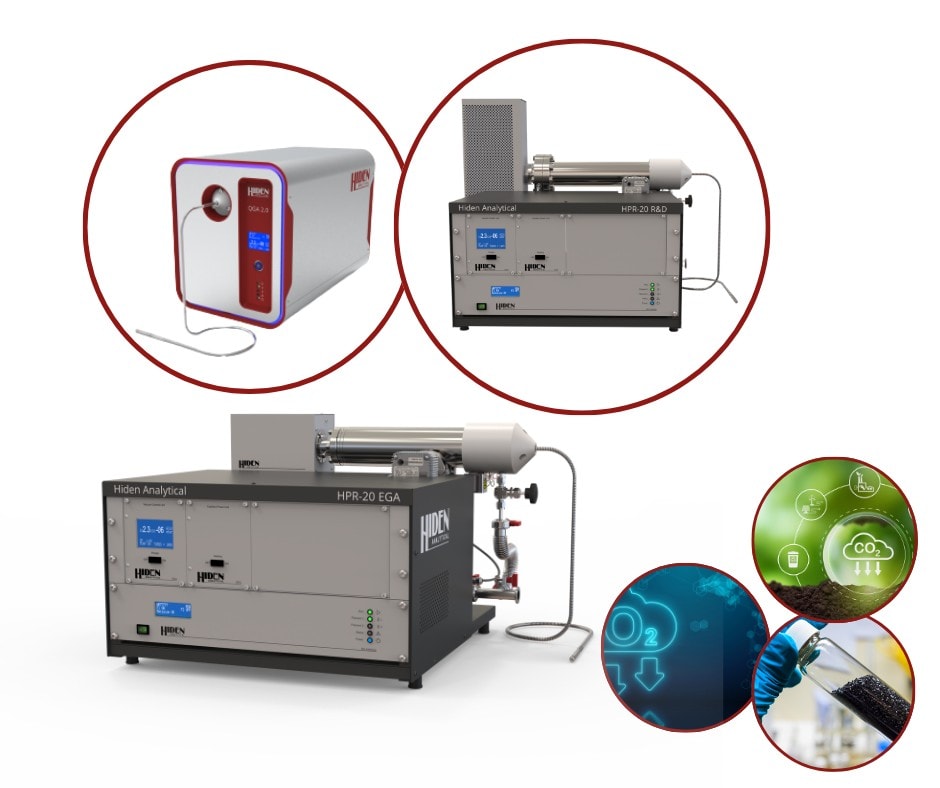
That’s why the QGA 2.0 sits nicely in carbon capture R&D: it’s designed for real-time quantitative gas analysis, spanning from trace to percent levels.
Let’s talk practical workflows. If I’m screening sorbents, what should I be measuring?
For sorbent screening, you’re usually trying to answer a range of questions: capacity (how much CO₂ is taken up), selectivity (CO₂ vs competing species, especially H₂O), kinetics (how fast uptake and release occur), and stability (what changes after cycling).
A mass spectrometer lets you track breakthrough curves in real time, CO₂, but also co-adsorbing gases and trace by-products, so you can see whether you’re getting “clean” adsorption or a more complex reactive capture behaviour.
What instrument would you point to first for breakthrough and cycle work?
For many labs, the QGA 2.0 is a strong starting point because it’s built for continuous quantitative monitoring of multiple gases and vapours, and it’s fast, sub-second response matters when you’re looking at sharp breakthrough fronts or PSA switching.
It also supports sampling across a range of pressures with appropriate inlet configurations, which is useful because capture studies often move between near-atmospheric experiments and elevated-pressure work.
Carbon capture is inseparable from regeneration. What’s the key measurement during desorption?
Two things: what comes off, and when it comes off.
During regeneration, thermal swing, pressure swing, vacuum swing, you can get structured desorption: fast release from weak sites, slower release from strong sites, and sometimes additional gases from decomposition or side reactions. Real-time MS is ideal for seeing those transitions clearly, especially when you’re optimising the regeneration window to minimise energy while still restoring capacity.
Where does the HPR-20 EGA come into carbon capture work?
The HPR-20 EGA is purpose-built for evolved gas analysis, particularly when researchers couple MS to thermogravimetric analysis (TGA-MS).
That’s very relevant to carbon capture materials because TGA tells you mass changes, adsorption, desorption, decomposition, but MS tells you what the mass change actually is. For example, distinguishing CO₂ desorption from the evolution of residual solvents, water, or decomposition fragments can be crucial when you’re judging long-term cyclability.
And the HPR-20 R&D, when does that become the right tool?
The HPR-20 R&D comes into its own when the research question is more demanding: higher sensitivity, more complex gas mixtures, or interfaces into bespoke reactors and rigs.
It’s designed for real-time analysis of evolved gases and vapours with high sensitivity and fast response, and it’s used across carbon capture and gas separation studies where you want deeper insight into trace formation pathways or low-level impurities.
What do you consider the most significant when interpreting datasets from carbon capture experiments?
The most common one is disregarding H₂O. Water can dominate adsorption competition, shift selectivity, and change apparent kinetics. Another is not accounting for time constants in sampling, long transfer lines, cold spots, or dead volume can smooth or delay transients, which leads to incorrect kinetic conclusions.
That’s why we put a lot of focus on appropriate sampling interfaces, heated inlets where needed, low-dead-volume configurations, and matching the inlet to the pressure regime, because the best analyser still needs an efficient sampling strategy.
Carbon capture is increasingly tied to utilisation. Does that change the analysis requirement?
Definitely. As soon as you move into CCU, CO₂ conversion, hydrogenation, catalytic upgrading, you’re no longer just measuring CO₂ slip. You’re measuring product formation, selectivity, transient intermediates, and catalyst state changes.
That tends to push you toward multi-species quantification at high time resolution, because catalytic systems can be highly dynamic, especially under switching feeds, pulsed operation, or operando studies.
Finally, if you could give one piece of advice to a capture researcher building a measurement stack, what would it be?
Design the analytics around the decision you need to make.
If you’re choosing between materials, you need clean breakthrough curves and reliable cycling data. If you’re optimising a process, you need fast transient response and stable quantification over long runs. And if you’re scaling, you need instrumentation that integrates into the workflow and keeps producing trustworthy data day after day.
Carbon capture is fundamentally an efficiency problem. Better measurements don’t just describe the system; they let you enhance it. And that’s exactly where real-time gas analysis earns its place.
David Lundie Biography
David Lundie is Technical Director at Hiden Analytical. He holds a degree in Chemistry and a PhD in Surface Chemistry and Catalysis, both from the University of Glasgow. David joined Hiden Analytical in 2003, bringing with him a expertise in catalysis and instrument design. Over the course of his career at Hiden, he took on the roles such as Product Manager for Catalysis and Thermal Analysis products. In 2022, he was appointed Technical Director, a role in which he leads technical development and product improvement across the company.
🔍Learn more about the QGA 2.0, the HPR-20 EGA and the HPR-20 R&D.
📩For further details, technical support, or to discuss your application with Dr. David Lundie, please contact us.